Best Whitening Toothpaste That Actually Works
Byline: Enamelly Editorial Team
Affiliate disclosure: Enamelly earns a commission on purchases made through links on this page at no extra cost to you. Our picks are based on ingredient analysis and aggregated user reviews, not paid placements.
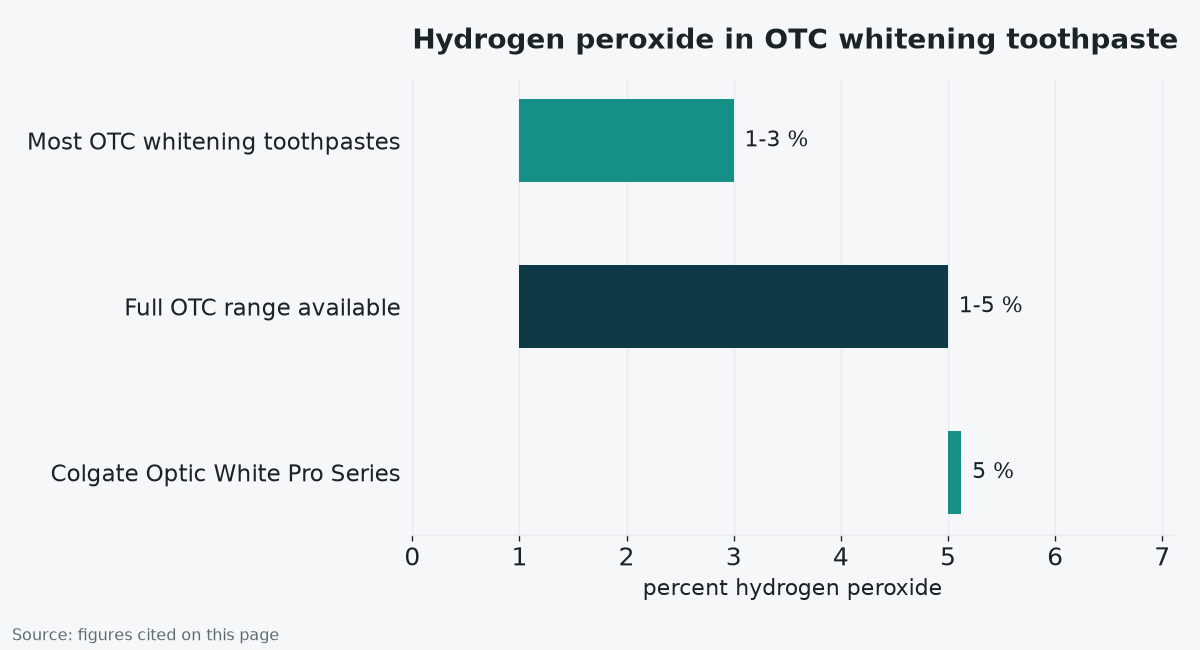
The best whitening toothpaste that actually delivers results is Colgate Optic White Pro Series, which contains 5% hydrogen peroxide, the highest concentration available in an OTC toothpaste. For sensitive teeth, Sensodyne Pronamel Gentle Whitening removes surface stains without triggering nerve sensitivity. If you want a clean-formula option free of peroxide and artificial ingredients, Lumineux Whitening Toothpaste is the strongest contender. All three are widely available and sold on Amazon right now.
Whitening toothpastes remove surface stains caused by coffee, tea, red wine, and tobacco. They do not bleach the natural color of your teeth from the inside out. That type of color change requires peroxide-based bleaching trays or in-office treatment. If your teeth are yellowed due to genetics, aging, or medications, a whitening toothpaste will improve surface brightness by a noticeable margin but will not transform your smile the way an in-office bleaching procedure would. The American Dental Association confirms this distinction on its Mouth Healthy resource: surface stains are extrinsic, and toothpaste can lift them; the natural color locked inside the dentin is intrinsic, and toothpaste cannot reach it. That is not a knock on these products. Knowing the actual mechanism helps you choose the right formula and set realistic expectations about what two minutes of daily brushing can accomplish.
Our team evaluated these products on four criteria: whitening mechanism (abrasive versus chemical versus optical), RDA score (Relative Dentin Abrasivity, the standardized measure of how hard a paste scrubs), sensitivity-friendliness, and ingredient transparency. We did not conduct first-hand clinical testing. Selections reflect ingredient analysis and aggregated consumer and clinical reviews.
If you are new to this category, our full guide to whitening toothpaste covers the science in more depth. If sensitivity is your primary concern, see our picks for sensitive teeth.
Quick Answer: Top Picks at a Glance
| Product | Whitening Mechanism | Best For | Sensitivity Risk |
|---|---|---|---|
| Colgate Optic White Pro Series | 5% hydrogen peroxide (chemical) | Maximum stain removal, healthy enamel | Moderate |
| Crest 3D White Advanced | Hydrogen peroxide + hydrated silica | All-rounder, everyday use | Low-moderate |
| Sensodyne Pronamel Gentle Whitening | Mild silica abrasion + potassium nitrate | Sensitive teeth | Very low |
| Arm & Hammer Advance White Extreme | Baking soda + low-level peroxide | Budget-friendly stain maintenance | Low |
| Lumineux Whitening Toothpaste | Aloe vera + essential oils (peroxide-free) | Clean-ingredient seekers | Very low |
| hello Activated Charcoal Epic Whitening | Activated charcoal + coconut oil (abrasion) | Fluoride-free, natural lifestyle | Low |
What Whitening Toothpaste Actually Does
Whitening toothpaste works on extrinsic stains only. These are the stains that sit on or near the outer enamel surface from coffee, tea, red wine, and tobacco. The American Dental Association states clearly on its Mouth Healthy resource that whitening toothpastes do not change the intrinsic color of teeth. Two mechanisms do the work: abrasive particles such as hydrated silica and baking soda that physically polish stains off the enamel surface, and chemical agents, primarily hydrogen peroxide at 1% to 5% in OTC products, that oxidize chromogen compounds at a slightly deeper surface level. A third category, optical brighteners such as blue covarine, shifts light reflection to create a perception of whiteness without altering the actual tooth surface. None of these mechanisms bleach dentin. High-abrasivity formulas (RDA above 150) carry a real risk of enamel wear when used aggressively over years.
Colgate Optic White Pro Series: Best Overall
Best for: People with healthy enamel who want the strongest OTC whitening available.
Colgate Optic White Pro Series carries a 5% hydrogen peroxide concentration, which makes it the most chemically active whitening toothpaste you can buy without a prescription. Most OTC whitening toothpastes contain between 1% and 3% hydrogen peroxide. This formulation also includes hydrated silica as a mild abrasive to help lift surface stains mechanically while the peroxide works on discoloration at a slightly deeper surface level.
Colgate holds a patent on this specific peroxide delivery system, which the brand calls “Optic Technology.” The formula is fluoride-containing, which matters if you are using it as your daily toothpaste rather than a supplemental one.
The trade-off is sensitivity. Five percent peroxide is safe for most people, but if your enamel is already thin or your gums are receded, you may notice increased tooth sensitivity after a few weeks of daily use. The fix is to alternate days rather than use it twice daily.
- Pros: Highest OTC peroxide concentration, ADA-accepted, fluoride included, available at most mass retailers
- Cons: Can increase sensitivity in those with thin enamel or gum recession

Crest 3D White Advanced: Best All-Rounder
Best for: Everyday whitening maintenance without overthinking it.
Crest 3D White Advanced pairs hydrogen peroxide with hydrated silica for a dual-action approach: the peroxide tackles staining at a chemical level while the silica buffs away residue from coffee, tea, and wine. The formula is fluoride-containing and the RDA falls in the low-to-medium range, meaning it is safe for twice-daily use on most enamel types.
This is the product that consistently appears across dentist recommendation lists as a practical starting point, not because it is the most aggressive option, but because the formulation is well-balanced. The silica abrasive is fine enough not to scratch enamel with normal brushing technique, and the peroxide concentration is effective without pushing into sensitivity territory for most users.
One nuance worth knowing: the Crest 3D White line has several sub-products with different peroxide concentrations and abrasivity levels. The “Advanced” line uses a consistent formula across markets. Check the packaging to confirm you are getting the hydrogen peroxide version and not the “whitening expression” variant, which is primarily abrasion-based.
- Pros: Widely available, balanced formula, solid track record in consumer reviews
- Cons: Peroxide concentration is lower than Pro Series; results take longer with heavy staining

Sensodyne Pronamel Gentle Whitening: Best for Sensitive Teeth
Best for: Anyone who gets zingers from cold drinks or has dentist-confirmed enamel erosion.
Sensodyne Pronamel Gentle Whitening takes a different approach to whitening from the peroxide-forward products above. Its active ingredients are potassium nitrate 5% (which calms nerve hypersensitivity by blocking tubular fluid movement in dentin) and sodium fluoride 0.25% for cavity protection and enamel remineralization. The whitening comes from a low-abrasion silica polish, not peroxide.
Per the DailyMed database maintained by the U.S. National Library of Medicine, the labeled active ingredients are specifically potassium nitrate 5% as the antihypersensitivity agent and sodium fluoride as the anticavity agent. This matters because it tells you what this toothpaste actually does: it primarily defends enamel and calms sensitivity, with whitening as a secondary benefit through surface polishing rather than chemical bleaching.
If your main concern is sensitivity, this is the strongest choice. If your main concern is whitening speed, this will not deliver the same visual results as the Colgate Pro Series. The two goals require different trade-offs.
For a broader look at options in this category, our guide to toothpastes for sensitive teeth and gums covers five additional formulas worth knowing about.
- Pros: Clinically proven sensitivity relief, enamel-strengthening fluoride, very low abrasion
- Cons: No peroxide means slower visible whitening; not the right pick if sensitivity is not an issue for you

Arm & Hammer Advance White Extreme: Best Budget Pick
Best for: Daily stain maintenance at the lowest price point.
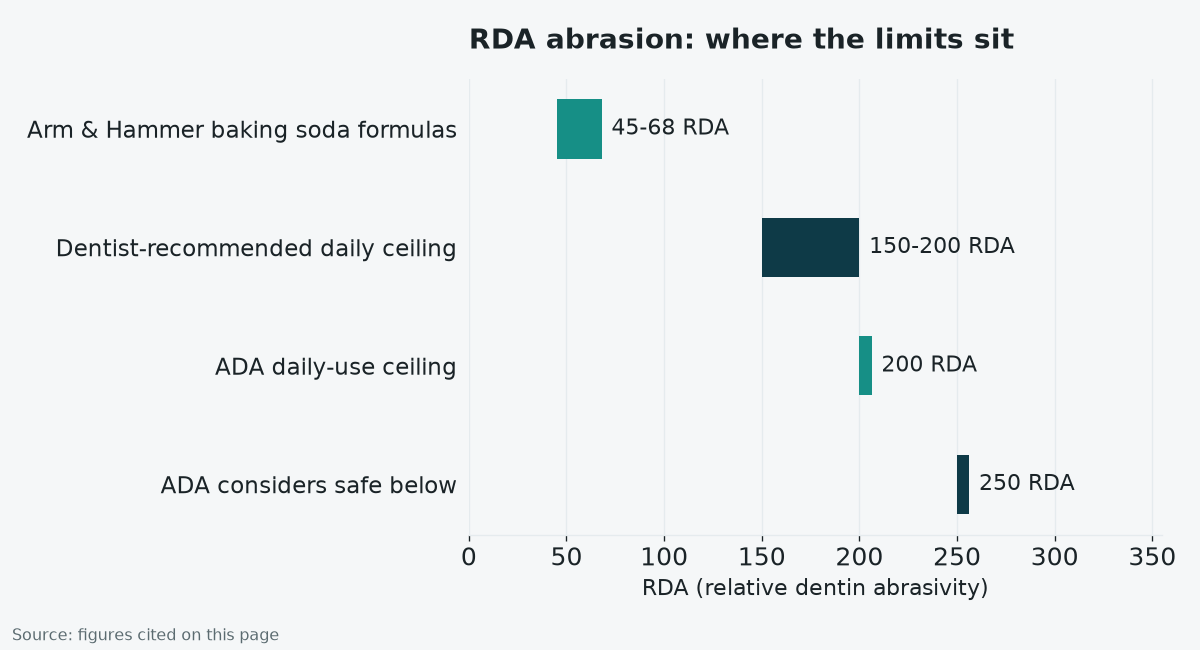
Arm & Hammer Advance White Extreme uses baking soda (sodium bicarbonate) as its primary abrasive combined with a low concentration of hydrogen peroxide. The baking soda RDA falls in the lower range of the abrasivity scale, which explains why the brand can market this as safe for everyday use. Historical RDA data from periodontics literature places Arm & Hammer baking soda-based peroxide formulas in the 45-68 RDA range depending on variant, well within the ADA-recommended 200 RDA ceiling for daily use.
The baking soda base gives it a distinctively mildly salty taste that some users find off-putting. It also creates an alkaline oral environment, which research suggests may modestly inhibit certain bacteria linked to plaque. That is a secondary benefit, not the main reason to buy it. The main reason is price: this is typically one of the most affordable whitening toothpastes per ounce on the shelf, and it works fine for people who are not dealing with heavy staining from years of coffee or wine consumption.
- Pros: Very low abrasion, budget-friendly, fluoride-containing, widely available
- Cons: Taste is polarizing; whitening effect is gradual and mild; not suited to significant existing staining

Lumineux Whitening Toothpaste: Best Clean-Formula Option
Best for: Ingredient-conscious buyers who want peroxide-free, SLS-free, and artificial-additive-free whitening.
Lumineux Whitening Toothpaste is the outlier in this list. It contains no hydrogen peroxide, no SLS (sodium lauryl sulfate, the foaming agent that can irritate canker sores), no artificial sweeteners, no fluoride, and no alcohol. The whitening mechanism relies on organic aloe vera, vegetable glycerin, and essential oils including lemon peel and coconut oil. The brand describes the formula as “certified clean” and markets it as dentist-formulated.
The trade-off is whitening potency. Without peroxide or aggressive abrasion, Lumineux works much more slowly than the chemical-forward options. It is best positioned as a maintenance product for people who have already achieved their whitening goals and want to maintain results without exposing their teeth to peroxide daily. It also suits people with reactive mouths who get irritation from most conventional toothpastes.
No fluoride is a real limitation if this is your only toothpaste and cavity protection matters to you. If you go this route, consider supplementing with a fluoride mouthwash.
- Pros: Peroxide-free, SLS-free, no artificial additives, very gentle, suitable for reactive mouths
- Cons: No fluoride; significantly slower whitening action than peroxide-based formulas

hello Activated Charcoal Epic Whitening: Best Fluoride-Free Natural Pick
Best for: Natural lifestyle buyers who want a fluoride-free, peroxide-free, SLS-free option with visible stain removal.
hello Activated Charcoal Epic Whitening uses activated charcoal as its whitening agent paired with coconut oil and fresh mint. The formula contains no peroxide, no fluoride, no artificial sweeteners, no SLS, and no titanium dioxide. It is vegan and has a strong following among buyers looking for a visibly cleaner ingredient list.
Charcoal toothpastes have a complicated reputation. The activated charcoal provides surface abrasion to lift stains, and some users report noticeable brightening, but clinical evidence specifically on activated charcoal toothpastes is thinner than for peroxide-based formulas. The concern that comes up repeatedly in dental literature is that some charcoal toothpastes have higher-than-expected abrasivity. The hello product’s own labeling does not state an RDA, and third-party testing results are not uniformly available, so this is an area of genuine uncertainty worth acknowledging.
The absence of fluoride is the biggest practical limitation. If you use this as your sole toothpaste, you are not getting fluoride protection. That is a meaningful trade-off worth discussing with your dentist if cavity prevention is a concern.
- Pros: No peroxide, no SLS, no fluoride, no artificial ingredients; vegan; strong natural-lifestyle appeal
- Cons: No fluoride protection; limited clinical data on charcoal abrasivity; whitening mechanism relies on surface abrasion only

How We Picked These Products
Last reviewed: June 2025. Products confirmed available on Amazon at time of review.
The Enamelly Editorial Team selected these products through ingredient and mechanism analysis combined with aggregated consumer and clinical reviews. We did not conduct in-person testing or receive payment from any brand. Products were included based on three criteria:
First, the whitening mechanism had to be clearly supported by the ingredient list. “Whitening” claims backed only by vague marketing language with no identifiable active mechanism were excluded.
Second, we cross-referenced products against the American Dental Association’s guidance on toothpaste safety and abrasivity. The ADA’s Mouth Healthy resource confirms that whitening toothpastes affect only extrinsic stains, not intrinsic tooth color. All products on this list carry RDA scores, confirmed or estimated from published data, that fall within the ADA’s recommended 200 RDA ceiling for daily use.
Third, we looked for real current availability on Amazon. Every product listed is actively sold at time of writing. Pricing changes frequently and we do not list prices to avoid outdating this content; check Amazon for current pricing.

What to Look for in a Whitening Toothpaste
Whitening Mechanism
There are three distinct mechanisms at work in whitening toothpastes, and knowing which you are buying matters:
Abrasive whitening uses particles like hydrated silica, calcium carbonate, or baking soda to physically polish stains from the tooth surface. It is effective on fresh stains and is generally low-risk if the RDA score is reasonable. The limitation is that it cannot address discoloration that has penetrated below the enamel surface.
Chemical whitening uses hydrogen peroxide or carbamide peroxide to oxidize chromogens (stain-causing compounds) at the enamel surface. Even at the low concentrations found in OTC toothpastes (1% to 5%), this mechanism reaches stains that abrasion alone cannot lift. It is more effective on stubborn staining but carries a higher sensitivity risk.
Optical brightening uses ingredients like blue covarine to shift how light reflects off the tooth, creating a perception of whiteness without changing the actual surface. Results are immediate but temporary and require daily use to maintain.
Purple toothpastes work on the same optical principle with a violet tint. Our Euthymol whitening toothpaste breakdown compares the pink stain-removal tube with the purple corrector.
RDA Score
Every toothpaste receives a Relative Dentin Abrasivity (RDA) score during formulation testing. The ADA considers anything below 250 RDA safe for daily use, but most dentists recommend staying at or below 150-200 for long-term twice-daily brushing. Low-abrasion pastes (RDA under 70) carry the least enamel risk. Whitening toothpastes typically fall between 45 and 200, depending on how aggressive the formula is. If a brand does not publish its RDA and cannot provide it on request, that is a gap worth noting.
Peroxide Concentration
OTC whitening toothpastes available in the US typically contain between 1% and 5% hydrogen peroxide. Prescription-strength bleaching gels go significantly higher. Five percent, found in Colgate Optic White Pro Series, is the current ceiling for what is sold over the counter and has a reasonable clinical track record for surface stain removal. Higher concentration does not always mean better results at home because contact time with toothpaste is short; it does mean higher potential for sensitivity.
Sensitivity Ingredients
If you have existing sensitivity, look for potassium nitrate (blocks nerve signal transmission in dentin) or stannous fluoride (precipitates at dentinal tubule openings to reduce fluid movement). Both are accepted desensitizing agents. Potassium nitrate at 5% is the standard effective concentration. For a deeper review of sensitivity-specific products, see our hydroxyapatite toothpaste guide, which covers HA-based formulas that remineralize enamel while gently brightening.
Frequently Asked Questions
Does whitening toothpaste actually work?
Yes, but only on extrinsic (surface) stains. The American Dental Association confirms that whitening toothpastes remove stains caused by food, drinks, and tobacco from the outer enamel surface. They do not change the natural color of teeth from the inside. If your teeth are yellowed due to aging, genetics, or medication, a whitening toothpaste will brighten the surface but will not produce the same results as a bleaching procedure.
How long does it take for whitening toothpaste to show results?
Most users see surface stain improvement within two to six weeks of twice-daily use. Peroxide-based formulas tend to show results faster than abrasion-only options. Stubborn staining from years of coffee or red wine use may take longer or require a higher-potency formula. Results also depend on whether you continue consuming staining foods and drinks during the process.
Can whitening toothpaste damage enamel?
Not at normal use frequency if the RDA score is within the ADA’s recommended range. The risk comes from high-abrasivity formulas used aggressively over a long period. Products with an RDA above 150, used with a hard-bristle brush and heavy pressure, can accelerate enamel wear. All products on this list fall within safe abrasivity parameters for twice-daily use.
Is peroxide-free whitening toothpaste effective?
It depends on what you are trying to achieve. Peroxide-free options like Lumineux and hello Charcoal work through surface abrasion and can remove mild surface staining. They are not capable of the same depth of stain removal as a 5% peroxide formula. For stain maintenance after whitening treatment, peroxide-free formulas are a reasonable choice. For significant active staining, they will likely underperform.
Should I use whitening toothpaste every day?
For most people, daily use of a whitening toothpaste with a moderate RDA score and fluoride is safe and appropriate as their primary toothpaste. High-peroxide formulas (4-5%) are best used once daily or alternated with a plain fluoride toothpaste, especially if you notice any increase in sensitivity. People with enamel erosion or gum recession should check with their dentist before committing to any whitening toothpaste as their sole daily paste.
What is the difference between whitening toothpaste and whitening strips?
Contact time is the key difference. Whitening strips use peroxide concentrations similar to or higher than OTC toothpastes, but they stay on your teeth for 30 minutes at a time rather than the two minutes of brushing. That extended contact allows the peroxide to penetrate enamel more thoroughly, which is why strips tend to produce faster and more dramatic color change than toothpaste alone. Whitening toothpaste is better positioned as a daily maintenance product or a first step for mild staining.