Best Fluoride-Free Toothpaste: 7 Picks That Actually Protect Your Teeth
By Enamelly Editorial Team | Reviewed against published dental research | Last updated June 2026
Affiliate disclosure: Enamelly earns a commission on qualifying purchases through Amazon links on this page, at no extra cost to you. Our picks are based on ingredient analysis and aggregated user data, not paid placement.
The best fluoride-free toothpaste for most adults is Boka Ela Mint, a nano-hydroxyapatite formula that remineralizes enamel through the same calcium-phosphate mechanism your body uses naturally. For anyone avoiding fluoride, nano-hydroxyapatite (n-Ha) is currently the most evidence-backed alternative, supported by peer-reviewed studies in the Journal of Clinical Dentistry and the Journal of Dentistry comparing its remineralization performance to fluoride. If n-Ha is your priority but Boka’s minty intensity bothers you, RiseWell Mineral Toothpaste runs milder. Want a zero-compromise natural formula with no SLS and no glycerin? Davids Premium Natural Toothpaste is the cleanest label on this list.
Fluoride-free toothpaste has a real audience: people with thyroid conditions flagging fluoride intake, parents managing young children who swallow paste, anyone following a strict clean-beauty routine, or those reacting to fluoride’s taste or texture. That said, going fluoride-free is not consequence-free. Fluoride has over 70 years of clinical evidence behind it. If you have a history of cavities or live in an area without fluoridated water, talk to your dentist before making the switch. This page exists to help you choose well if you have already decided to go that route, not to push you there.
Our fluoride-free toothpaste guide covers the full science, including how n-Ha compares to fluoride in head-to-head trials. This roundup focuses on the products themselves.
Quick Comparison: Best Fluoride-Free Toothpastes
The table below maps each product’s active remineralizing agent, SLS status, and primary use case. The distinction between nano-hydroxyapatite formulas (Boka, RiseWell) and cleaning-focused formulas (Hello, Tom’s, Dr. Bronner’s) is the single most important axis for anyone switching from fluoride for cavity protection reasons. Xylitol-forward products like Jack N’ Jill occupy a separate lane: they work by reducing bacterial adhesion rather than direct enamel repair, making them appropriate for children but a weaker standalone choice for adults at cavity risk.
| Product | Active Remineralizer | SLS-Free | Best For | Flavor Options |
|---|---|---|---|---|
| Boka Ela Mint | Nano-hydroxyapatite | Yes | Best overall / enamel remineralization | Mint, Coco Ginger, Watermelon Mint |
| RiseWell Mineral Toothpaste | Nano-hydroxyapatite | Yes | Sensitive mouths, mild flavor preference | Wild Mint, Kids Strawberry Banana |
| Davids Premium Natural Toothpaste | Calcium carbonate (mild abrasive) | Yes | Purest ingredient list, whitening focus | Spearmint, Peppermint, Charcoal+Peppermint |
| Hello Antiplaque + Whitening | Hydrated silica | Yes | Budget-friendly, widely available | Fresh Mint, Activated Charcoal |
| Tom’s of Maine Fluoride-Free | Hydrated silica | Yes | Brand trust, mainstream availability | Spearmint, Peppermint |
| Dr. Bronner’s All-One Toothpaste | Calcium carbonate | Yes | Anise/fennel fans, whole-ingredient philosophy | Peppermint, Spearmint, Anise, Cinnamon |
| Jack N’ Jill Natural Toothpaste | Xylitol | Yes | Toddlers and young children | Raspberry, Strawberry, Blueberry, Bubblegum |
Boka Ela Mint Nano-Hydroxyapatite Toothpaste: Best Overall
Best for: Adults prioritizing enamel remineralization without fluoride
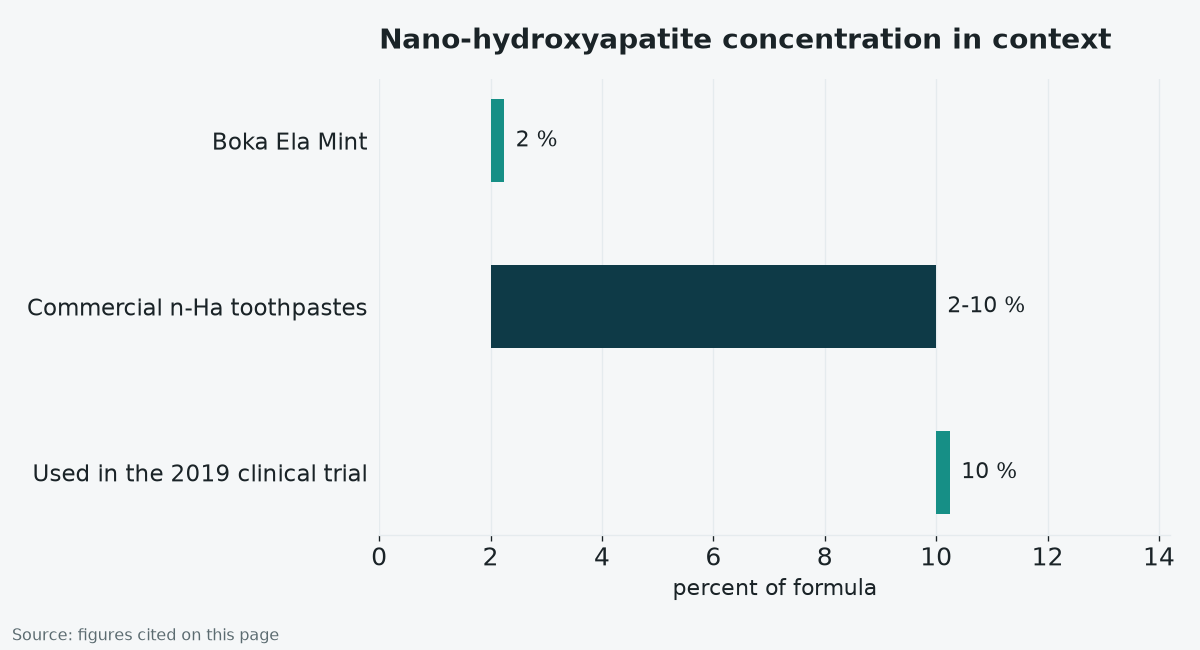
Boka Ela Mint is built around nano-hydroxyapatite, a form of calcium phosphate that integrates directly into enamel crystals to fill microscopic fissures and early demineralization spots. This is the same mineral that makes up roughly 97% of your tooth enamel by weight. Several randomized controlled trials have confirmed that 10% nano-hydroxyapatite performs comparably to 1,000 ppm fluoride toothpaste on remineralization endpoints, including a 2019 study published in the Journal of Clinical Dentistry. Boka uses a 2% nano-hydroxyapatite concentration, which sits within the studied therapeutic range. One limitation worth noting: most n-Ha trials to date have been short-duration (12 weeks or less) and conducted in vitro or in small clinical samples. The evidence is promising and growing, but the long-term real-world data set is thinner than the 70-year fluoride record. For low-to-moderate cavity risk adults, that gap is acceptable. For high-risk patients, it is a reason to stay with fluoride until longer-term n-Ha data accumulates.
The formula is SLS-free, glycerin-free, and uses erythritol as a sweetener rather than saccharin. The “Ela Mint” flavor lands at medium intensity; not aggressive, but present enough to signal clean. Boka also offers Coco Ginger and Watermelon Mint variants for those who find straight mint too sharp. If you want to read more about why nano-hydroxyapatite is the standout active ingredient in this category, the hydroxyapatite toothpaste guide covers the mechanism in detail.
Pros:
- Best-studied fluoride alternative on this list
- No SLS, no glycerin, no saccharin
- Multiple flavor options
- Remineralizes and reduces sensitivity simultaneously
Cons:
- Higher price point than mainstream brands
- Not sold in most brick-and-mortar stores (primarily DTC and Amazon)
RiseWell Mineral Toothpaste: Best for Sensitive Mouths
Best for: Adults who want nano-hydroxyapatite in a gentler, lower-mint formula
RiseWell Mineral Toothpaste is the other serious n-Ha contender in the US market. Like Boka, it uses hydroxyapatite as the primary remineralizing agent. Where it differs is texture and intensity. RiseWell runs slightly thicker and its Wild Mint flavor is noticeably milder, which matters if you have oral sensitivities or find the cooling sensation of stronger mints irritating. The brand was co-founded by a former dentist and positions itself squarely at the professional oral care consumer.
The ingredient list is clean: hydroxyapatite, xylitol (which has its own evidence base for reducing Streptococcus mutans counts), coconut oil, and colloidal silver as an antimicrobial support. No SLS, no artificial sweeteners, no carrageenan. RiseWell also produces a kids’ version in Strawberry Banana that uses a lower n-Ha concentration appropriate for early enamel development, making it one of the few n-Ha options designed for children. Read more about evaluating the fluoride-free category holistically before committing to any single brand.
One note on the colloidal silver: its antimicrobial evidence in oral care is mixed, and several holistic health practitioners consider it unnecessary when xylitol and n-Ha are already present. If that ingredient concerns you, Boka is the cleaner alternative at a comparable price.
Pros:
- Clinically grounded active ingredient (n-Ha)
- Mild enough for sensitive oral tissues
- Kids formula available
- Xylitol adds antibacterial support
Cons:
- Premium pricing
- Colloidal silver is polarizing; evidence in oral care is limited
Davids Premium Natural Toothpaste: Cleanest Ingredient Label
Best for: Clean-beauty focused users who want whitening without fluoride or SLS
Davids Premium Natural Toothpaste takes a different approach than the n-Ha formulas. Its primary cleaning action comes from calcium carbonate, a mild abrasive that polishes surface stains, plus perlite (volcanic glass microspheres) for additional whitening in some variants. There is no nano-hydroxyapatite here. The remineralization pitch is softer, relying on the mouth’s natural saliva to replenish minerals rather than a synthetic delivery agent.
What Davids does exceptionally well is the label. The formula is SLS-free, artificial preservative-free, vegan, and packed in a recyclable US-made metal tube, which resonates with the sustainability-conscious buyer. Davids has earned enough retailer placement that you can find it at Target and Whole Foods, which is unusual for a premium natural toothpaste. The whitening effect is real and user-reported whitening satisfaction scores on aggregated retail reviews are consistently high for the Spearmint and Charcoal+Peppermint SKUs. The trade-off: without n-Ha, this is less a remineralizer and more a thorough cleaner.
Pros:
- Strictest “clean” formulation on this list
- Widely available (Target, Whole Foods, Amazon)
- Effective whitening through polishing
- Recyclable metal packaging
Cons:
- No nano-hydroxyapatite; weaker remineralization claim
- Some users find the calcium carbonate texture gritty
Hello Antiplaque + Whitening Fluoride-Free Toothpaste: Best Budget Pick
Best for: Shoppers who want a certified natural, SLS-free formula at a mainstream price
Hello Antiplaque + Whitening is the most approachable entry point on this list. Hello Oral Care holds a Leaping Bunny cruelty-free certification and positions itself in the natural drugstore tier. The active ingredient here is hydrated silica, a standard abrasive that cleans and polishes without the remineralizing claims of n-Ha. That is an honest trade-off at this price tier.
The formula contains xylitol and tea tree oil for antimicrobial support, is SLS-free, and carries no artificial dyes. Hello is sold at CVS, Walgreens, Target, and Amazon with enough volume that you are never hunting for it. If you are testing fluoride-free for the first time and want to keep costs low before committing to a premium brand, Hello is the sensible starting point. The Activated Charcoal variant gets consistent marks for surface stain removal, though charcoal’s enamel safety remains a subject of ongoing dental research discussion, and the American Dental Association has not endorsed charcoal toothpastes.
Pros:
- Accessible price, mass-retail distribution
- Leaping Bunny certified cruelty-free
- SLS-free, no artificial sweeteners or dyes
Cons:
- No remineralizing active ingredient
- Charcoal variant carries abrasion caveats; ADA has not endorsed charcoal toothpastes
The quarter-gram figure is the pea-sized amount dentists recommend for adults, and most people squeeze out two to three times that because toothpaste adverts show a full brush head. Using the correct amount is what makes an expensive hydroxyapatite tube affordable, and children under three should get a rice-grain smear instead.
Tom’s of Maine Fluoride-Free Toothpaste: Best for Brand Familiarity
Best for: Households transitioning from conventional toothpaste who want a trusted, familiar format
Tom’s of Maine has been the default gateway brand for natural oral care since the 1970s and its fluoride-free Antiplaque line reflects that legacy. The active system uses hydrated silica for cleaning alongside zinc citrate for tartar prevention. It is ADA-accepted for its tartar control claim and carries non-GMO verification. What it lacks is a serious remineralizing agent, positioning it alongside Hello as a cleaning-focused rather than remineralization-focused product.
Tom’s earns its place here because of sheer availability and format comfort. If you are buying for a household with mixed preferences or a partner who is skeptical of switching, a Tom’s tube feels recognizably like toothpaste. The Spearmint flavor is mild, the texture is familiar, and the price sits below the premium tier. For someone committed to long-term fluoride-free use and cavity prevention, upgrading to a nano-hydroxyapatite formula makes more sense, but Tom’s is a valid short-term or transitional choice.
Pros:
- ADA tartar control acceptance
- Non-GMO verified, widely trusted brand
- Available in virtually every grocery and drugstore
Cons:
- No nano-hydroxyapatite; lighter on cavity protection
- Some SKUs contain carrageenan (check label)
Dr. Bronner’s All-One Toothpaste: Best for Ingredient Purists
Best for: Users who want the fewest possible ingredients and can tolerate non-mint flavors
Dr. Bronner’s All-One Toothpaste reads like a mineral ingredient list: calcium carbonate, coconut oil, water, baking soda, and essential oils. That is close to the full list. No thickeners, no glycerin, no synthetic abrasives, no foaming agents. The cleaning mechanism is a combination of physical polishing from calcium carbonate and the mild antimicrobial effect of coconut oil. Baking soda contributes a lightly alkaline pH, which research associates with reduced Streptococcus mutans activity.
Where Dr. Bronner’s is genuinely unusual is flavor. The Anise and Cinnamon variants are formulated for people who dislike mint entirely, a meaningful gap given that mint is the default across almost every other brand on this list. If you are introducing young children who find mint too sharp, or if you personally react to menthol, the Anise variant is one of the very few non-mint adult fluoride-free options with a clean label. The texture is paste-thin and the abrasion level is gentle, which limits whitening power but protects sensitive enamel.
Pros:
- Exceptionally short, recognizable ingredient list
- Non-mint flavors available (Anise, Cinnamon)
- Fair Trade certified coconut oil
- Low abrasion; safe for sensitive enamel
Cons:
- No remineralizing active ingredient
- Thin paste texture; less familiar feel
- Anise/cinnamon flavors are not for everyone
Jack N’ Jill Natural Toothpaste: Best for Toddlers and Young Children
Best for: Children under 6 who are likely to swallow toothpaste
Jack N’ Jill Natural Toothpaste is an Australian brand with strong pediatric positioning and certified organic credentials. Its primary active cavity-protection ingredient is xylitol, a sugar alcohol that reduces the ability of Streptococcus mutans bacteria to adhere to tooth surfaces, thereby lowering the acid production that causes decay. The American Academy of Pediatric Dentistry recognizes xylitol-containing products as useful adjuncts for caries prevention, though the evidence is not as strong as for fluoride in high-risk children.
The formula is swallowable, which is the defining advantage for the under-3 crowd. Flavors include Raspberry, Strawberry, Bubblegum, and Blueberry, all mild enough that children actually accept them. Certified organic ingredients, bioplastic packaging, and a vegan certification complete the picture. For children under 3 years or those at elevated cavity risk, the American Dental Association still recommends a rice grain-sized amount of fluoride toothpaste; talk to your child’s pediatric dentist about the right choice given their specific risk profile.
Pros:
- Safe if swallowed; age-appropriate formula
- Xylitol provides meaningful caries reduction evidence
- Certified organic, bioplastic packaging
- Flavors children actually accept
Cons:
- Xylitol evidence base weaker than fluoride for high-risk children
- Pediatric dentist consultation recommended before choosing for cavity-prone kids
How We Selected These Products
Every product on this list went through the same evaluation framework. First, we analyzed the full ingredient list against published dental research, focusing on whether the formula contained a substantiated remineralizing or cavity-preventive agent: nano-hydroxyapatite, xylitol, calcium carbonate, or zinc compounds. Products relying solely on “natural flavoring” or essential oils with no clinical support for caries reduction were excluded.
Second, we checked SLS status. Sodium lauryl sulfate is a foaming agent associated with increased canker sore frequency in susceptible individuals, and a meaningful portion of people switching to fluoride-free toothpaste are doing so precisely because they are reacting to conventional formulas. A fluoride-free product that still contains SLS solves only half the problem.
Third, we cross-referenced aggregated user ratings across Amazon, independent oral care review sites, and r/OralHealthcare discussions to weight real-world user satisfaction. We did not test these products ourselves; our selection criteria are ingredient analysis, published literature, and aggregated consumer data. Several brands we considered did not make the final list because their active ingredient claims lacked peer-reviewed support or their SLS-free claims were limited to specific SKUs rather than the full line.
Brands reviewed and excluded: Himalaya Botanique (SLS present in most SKUs), Desert Essence Tea Tree (no substantiated remineralizing agent), Colgate Enamel Health Mineral Repair (fluoride formula, out of scope), and several charcoal-only brands whose abrasion levels and enamel safety we could not verify from published RDA data. The American Dental Association published a position in 2017 in the Journal of the American Dental Association (Hara et al.) noting insufficient evidence to support the safety and efficacy of charcoal toothpastes, which disqualified charcoal-primary formulas from our list. We included Hello’s charcoal variant only as an optional SKU within a brand whose base formula met our criteria.
The Fluoride-Free Ingredient Hierarchy
The single most important thing to look for in a fluoride-free toothpaste is whether it contains a substantiated remineralizing agent. Based on the published dental research reviewed for this roundup, the hierarchy currently looks like this.
Nano-hydroxyapatite sits at the top of the evidence pyramid for fluoride-free remineralization. It is a synthetic calcium phosphate compound identical in composition to the mineral matrix of tooth enamel. At the nano scale, it integrates directly into demineralized enamel crystals, filling early lesions and reducing sensitivity. Multiple randomized controlled trials, including a 2019 study in the Journal of Clinical Dentistry and earlier work published in the Journal of Dentistry, have shown 10% n-Ha to be comparable to 1,000 ppm fluoride on remineralization endpoints in controlled settings. For adults seeking the strongest fluoride-free cavity protection available without a prescription, n-Ha is the only ingredient with that level of evidence.
Below that is xylitol, which does not remineralize enamel but meaningfully reduces acid-producing bacteria by blocking Streptococcus mutans adhesion. Then calcium carbonate and hydrated silica, which clean and polish but do not remineralize. At the bottom: formulas that offer none of these, relying purely on essential oils or marketing claims with no peer-reviewed cavity protection data.
SLS-free status matters for a significant minority of users. If you have recurrent mouth ulcers or a history of oral irritation with standard toothpastes, an SLS-free formula frequently reduces symptoms within two to four weeks, based on findings from a 1994 randomized trial in the Journal of Clinical Periodontology that found a statistically significant reduction in aphthous ulcer frequency with SLS-free paste. Abrasivity is worth considering if you use a stiff-bristle brush. Relative Dentin Abrasivity (RDA) values vary widely across this category. Baking soda and calcium carbonate formulas typically run low-abrasion (RDA under 70), while charcoal and perlite formulas can run higher. No brand on this list publishes its RDA value, which is a transparency gap worth noting. High-cavity-risk users should discuss any fluoride-free transition with their dentist, because individual risk factors including diet, saliva composition, history of decay, and proximity to fluoridated water determine whether a fluoride-free formula is the right call for their specific situation.
Choosing a fluoride-free toothpaste comes down to three variables: your cavity risk level, your sensitivity to SLS, and how important sustainability or clean-label credentials are to you. If your cavity risk is low and you want the strongest fluoride-free protection available, pick a nano-hydroxyapatite formula, specifically Boka or RiseWell. Both use the ingredient backed by randomized controlled trial data showing equivalence to 1,000 ppm fluoride in remineralization. If cavity protection is secondary and you prioritize a minimal ingredient list or whitening performance, Davids or Dr. Bronner’s are the right lane. For children who swallow paste, Jack N’ Jill’s xylitol formula is the only product on this list designed specifically for safe ingestion. In every case: if you have active cavities, a history of frequent decay, or live outside a fluoridated water area, talk to your dentist before committing to a fluoride-free routine. That conversation costs nothing and the information it gives you is worth more than any toothpaste review.
Frequently Asked Questions
Is fluoride-free toothpaste as effective as fluoride toothpaste for cavity prevention?
Fluoride remains the most studied cavity prevention agent in dentistry, with over seven decades of clinical evidence. Nano-hydroxyapatite is the closest fluoride-free alternative, with several peer-reviewed trials showing comparable remineralization in controlled settings. For low-cavity-risk adults with good saliva flow and a stable diet, a quality n-Ha formula is a reasonable fluoride-free choice. For children or high-risk adults, the evidence still favors fluoride.
What is nano-hydroxyapatite and why is it the top fluoride-free ingredient?
Nano-hydroxyapatite is a synthetic form of calcium phosphate, the same mineral that makes up approximately 97% of tooth enamel. At the nano scale, it integrates into enamel crystal structure to fill demineralized areas and reduce sensitivity. A 2019 randomized controlled trial in the Journal of Clinical Dentistry found 10% n-Ha comparable to 1,000 ppm fluoride on remineralization. Most commercial n-Ha toothpastes use concentrations between 2% and 10%.
Is fluoride-free toothpaste safe for children?
Age and cavity risk determine the right choice. For children under 3 who routinely swallow toothpaste, a swallowable fluoride-free formula like Jack N’ Jill avoids the fluorosis risk that comes from fluoride ingestion at that age. For children 3 and older, the American Dental Association recommends a pea-sized amount of fluoride toothpaste. Children at elevated decay risk should use fluoride regardless of age, per their pediatric dentist’s guidance.
Does fluoride-free toothpaste still work for whitening?
Whitening in any toothpaste category comes from abrasion and surface stain removal, not from the fluoride or n-Ha itself. Davids (with perlite and calcium carbonate) and Hello (with hydrated silica) perform well on surface stain removal. Boka and RiseWell focus on remineralization rather than whitening. None of the products on this list use peroxide, so the whitening effect is limited to extrinsic stain clearance rather than internal tooth brightening.
Can you use fluoride-free toothpaste if you already have cavities?
Active cavities require dental treatment first. Once treated, a nano-hydroxyapatite formula may help remineralize early lesions around the margins, but it is not a replacement for restorative care. If you have a recent history of multiple cavities, talk to your dentist before switching away from fluoride; your risk profile may make the fluoride advantage worth keeping.
What does SLS-free mean and should I care about it?
Sodium lauryl sulfate (SLS) is a foaming surfactant in most conventional toothpastes. It creates lather but has no therapeutic benefit. Studies, including a 1994 trial in the Journal of Clinical Periodontology, found a statistically significant increase in aphthous ulcer frequency with SLS-containing toothpaste in susceptible individuals. If you get recurrent canker sores and currently use a conventional paste, switching to an SLS-free formula is one of the first interventions oral medicine specialists often recommend.