Nano-Hydroxyapatite vs Fluoride: Which Actually Protects Your Teeth?
By Enamelly Editorial Team | Last reviewed: June 2026
Editorial note: Enamelly earns revenue from links to product guides on this site. Our editorial positions are based on published clinical research and are not influenced by affiliate relationships.
Both ingredients protect enamel and reduce cavities, but through entirely different mechanisms. Fluoride has decades of clinical evidence and remains the global standard endorsed by the American Dental Association. Nano-hydroxyapatite (nano-HAp) is a newer, fluoride-free approach that builds enamel using the same mineral your teeth are made of, with a growing body of peer-reviewed research behind it. Neither is a clear winner for everyone; the right choice depends on your cavity risk, age, and personal preferences around fluoride.
Quick verdict: Fluoride is the most-studied and most effective option for high cavity-risk individuals and children in fluoride-deficient areas. It forms a harder, more acid-resistant compound called fluorapatite and has a direct antibacterial effect on cavity-causing bacteria. Nano-hydroxyapatite is a scientifically credible, fluoride-free alternative best suited for low-to-moderate cavity risk, people avoiding fluoride for personal or medical reasons, and anyone dealing with tooth sensitivity. It works by depositing the same calcium phosphate mineral teeth are made of directly onto the enamel surface. For many adults with consistent brushing habits and moderate cavity risk, either ingredient used regularly delivers meaningful protection. The strongest differentiator is the safety profile for young children: nano-HAp carries no fluorosis risk. Japan has used nano-HAp toothpaste since the 1980s with an established pediatric safety record and full Ministry of Health approval as an anti-cavity agent.
How Fluoride Protects Your Enamel
Fluoride works by integrating into the crystalline structure of your enamel. When acid from bacteria dissolves calcium and phosphate from enamel (demineralization), fluoride accelerates the remineralization process and forms fluorapatite, a compound harder and more acid-resistant than the original hydroxyapatite mineral that teeth are naturally made of.
Fluoride also has a direct antibacterial effect on Streptococcus mutans, the primary cavity-causing bacterium. At even low concentrations, it disrupts the enzyme that bacteria use to metabolize sugar and produce acid, which reduces acid production at the source rather than just repairing damage after the fact.
The evidence base here is substantial. Fluoride toothpaste has been studied in controlled trials since the 1940s. The ADA, the World Health Organization, and the CDC all recognize community water fluoridation and fluoride toothpaste as among the most cost-effective public health interventions for dental caries prevention.
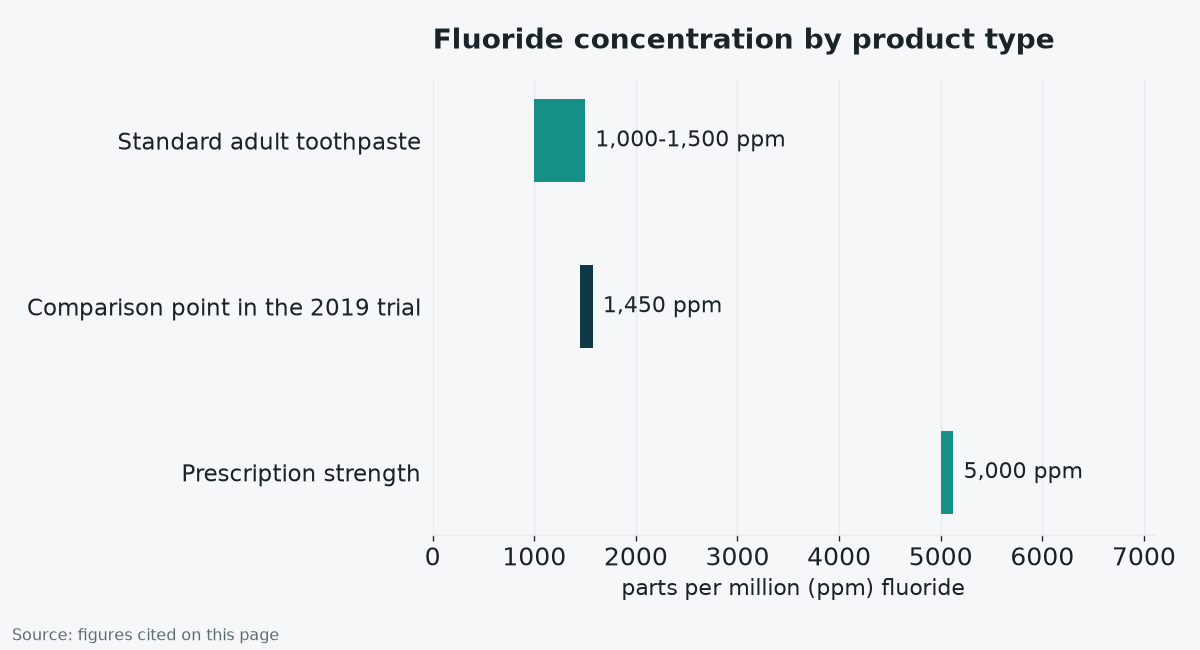
Standard adult toothpastes contain 1,000 to 1,500 ppm (parts per million) of fluoride. Prescription-strength formulas reach 5,000 ppm for patients with very high cavity risk or active decay.
How Nano-Hydroxyapatite Works
Nano-hydroxyapatite takes a biomimetic approach. Rather than changing the mineral composition of your enamel, it deposits the same calcium phosphate mineral your teeth are made of directly onto the enamel surface. The nanoparticle size (roughly 20 to 80 nanometers in diameter) allows the material to fill microscopic surface defects, early erosion lesions, and exposed dentinal tubules.
The mechanism for cavity prevention is primarily remineralization: nano-HAp particles adsorb onto enamel, release calcium and phosphate ions, and fill in subsurface lesions before they progress into full cavities. A 2023 comprehensive review by Pushpalatha et al., published in the Saudi Dental Journal and indexed in PMC (PMC10562112), confirmed nano-HAp’s remineralization and desensitization mechanisms as “comparable to conventional fluoride formulations” for early enamel lesions, noting that the biomimetic mineral directly integrates with enamel crystallites rather than forming a chemically altered surface compound.
Earlier controlled studies reinforced this picture. A 2019 trial in Clinical Oral Investigations found 10% nano-HAp toothpaste performed comparably to 1,450 ppm fluoride at remineralizing artificial enamel lesions. A randomized controlled trial by Tschoppe et al. (2011), published in the Journal of Clinical Dentistry, reported similar remineralization potential between 10% nano-HAp and fluoride formulations under standardized conditions.
For sensitivity, nano-HAp has a particularly strong record. It physically occludes exposed dentinal tubules, the microscopic channels that transmit pain signals when enamel is worn. Multiple clinical studies have reported significant reductions in dentinal hypersensitivity with regular nano-HAp use. If sensitivity is your main concern, this is worth taking seriously as a documented mechanism, not a marketing claim.
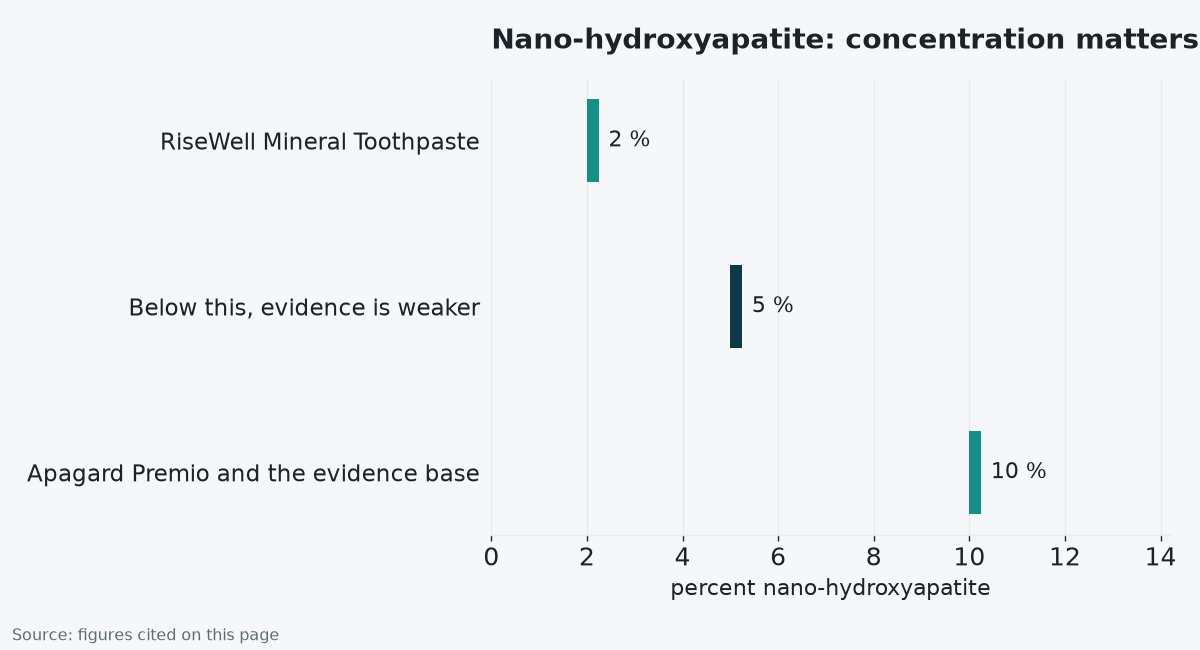
Products like Risewell Mineral Toothpaste (2% nano-HAp) and Apagard Premio (10% hydroxyapatite, the Japanese original from SANGI Co., Ltd.) represent the range from everyday formulations to the clinical concentrations studied in trials. Concentration matters: the remineralization evidence is built primarily on 10% nano-HAp, not lower-concentration cosmetic uses. When reviewing nano-HAp toothpastes for this site, we cross-reference the declared concentration against the manufacturer’s INCI ingredient list, where ingredients must appear by descending concentration, and check whether the product specifies particle size (nano) versus listing generic hydroxyapatite as a filler.
You can find a deeper breakdown of how the ingredient works and which products use pharmaceutical-grade concentrations in our complete hydroxyapatite toothpaste guide.
Enamelly earns a commission on qualifying Amazon purchases made through these links, at no extra cost to you.


Evidence Comparison: Where the Science Stands
Fluoride is backed by over 70 years of clinical and epidemiological research. The sheer volume of evidence, across population-level studies, randomized controlled trials, and systematic reviews, is not matched by any other dental ingredient. That matters when evaluating safety and efficacy claims.
Nano-hydroxyapatite has a shorter but accelerating research history. Most clinical studies date from the 2000s onward, with significant contributions from Japanese and European research groups. A systematic review in BDJ Open (2020) concluded that nano-HAp shows “promising results” for enamel remineralization but noted that large-scale long-term randomized controlled trials under natural cavity conditions remain limited compared to fluoride’s evidence base. The 2023 review by Pushpalatha et al. in Saudi Dental Journal surveyed the broader literature and found consistent support for nano-HAp in remineralization, desensitization, and antibacterial biofilm disruption, reinforcing that the evidence trajectory is clearly upward.
The honest summary: fluoride is proven at population scale across diverse dietary and oral hygiene habits. Nano-HAp is credibly supported for remineralization and sensitivity, with growing but not yet equivalent clinical depth. If your primary goal is maximum cavity prevention and you have no concerns about fluoride, the evidence slightly favors fluoride, particularly at higher cavity risk levels. The evidence hierarchy remains: fluoride proven at all risk levels, nano-HAp proven for early lesions and sensitivity.
What the 2023 Research Review Actually Says
The most comprehensive recent synthesis is the 2023 review by Pushpalatha C, Gayathri VS, Sowmya SV, Augustine D, and colleagues, published in Saudi Dental Journal (35(6):741-752, doi: 10.1016/j.sdentj.2023.05.018) and freely accessible via PMC (PMC10562112). The review evaluated nano-HAp across remineralization, desensitization, antibacterial activity, and biocompatibility across multiple independent research groups. Key findings: nano-HAp at 10% concentration consistently remineralizes early enamel lesions at rates comparable to standard fluoride; it physically occludes dentinal tubules with measurable efficacy in sensitivity reduction; nanoparticles adsorb to enamel crystallites and release calcium and phosphate ions in a sustained manner; the ingredient is biocompatible with no systemic safety signals in the reviewed literature. The review authors note that fluoride trial volume across diverse populations remains unmatched, but for patients with sensitivity or those avoiding fluoride, nano-HAp represents a clinically grounded choice.
Source: Pushpalatha C et al. “Nanohydroxyapatite in dentistry: A comprehensive review.” Saudi Dent J. 2023 Jun 7;35(6):741-752. PMC10562112.
Safety: Fluoride and Swallowing Risk
Fluoride has a well-documented therapeutic window. At normal toothpaste concentrations, swallowing a small amount while brushing is not acutely dangerous for adults. The concern is chronic overexposure in children during enamel development.
Dental fluorosis occurs when children under 8 ingest too much fluoride during the years their permanent teeth are forming. Mild fluorosis appears as faint white streaks on teeth and is primarily cosmetic. Severe fluorosis, associated with significantly elevated intake, is rare in the United States due to regulated water fluoridation levels. The ADA recommends using only a rice-grain amount of fluoride toothpaste for children under 3, and a pea-sized amount for children 3 to 6, specifically to minimize swallowing risk.
For adults, fluoride at standard toothpaste concentrations poses no safety concern with normal use. Concerns about systemic fluoride effects (thyroid, bone, neurological) at levels found in fluoridated water and toothpaste have not been substantiated in the mainstream clinical literature, though the topic remains debated in some circles.
Safety of Nano-Hydroxyapatite for Children
This is where nano-HAp has a practical advantage for parents. Because hydroxyapatite is the same mineral found in bone and teeth, it is biologically inert when swallowed in small quantities. There is no equivalent of fluorosis risk. Young children who inevitably swallow some toothpaste are not accumulating a potentially toxic mineral.
Japan, where nano-HAp toothpaste has been in use since the 1980s after being developed by SANGI Co., Ltd. under a NASA-inspired biomaterials program, has an extensive safety record in children. The ingredient is approved by the Japanese Ministry of Health as an anti-cavity agent.
In the United States, nano-HAp is not yet an ADA-accepted anti-cavity agent because formal ADA acceptance requires a specific submission process from manufacturers, not simply the existence of clinical evidence. “Not ADA-accepted” does not mean “not effective”; it means the formal acceptance process has not been completed for this ingredient in the US market.
Sensitivity Relief: A Clear Edge for Nano-HAp
If dentinal hypersensitivity is driving your toothpaste choice, nano-hydroxyapatite has an advantage that is well-supported by clinical data. The nanoparticles are small enough to physically block dentinal tubules, reducing fluid movement that triggers pain when you eat or drink something cold, hot, or sweet.
Standard sensitivity toothpastes typically use potassium nitrate (to desensitize nerve signals) or stannous fluoride (which provides some tubule occlusion alongside fluoride protection). Nano-HAp provides tubule occlusion without the fluoride component, which is meaningful for people who want sensitivity relief and are also avoiding fluoride for personal or medical reasons. The Pushpalatha et al. (2023) review documented this occlusion mechanism as one of nano-HAp’s most consistently supported clinical properties, with multiple independent trials showing measurable tubule sealing at 10% concentration.
If you want a curated shortlist of nano-HAp products with verified concentration levels and sensitivity claims, our best hydroxyapatite toothpaste guide ranks current options by ingredient quality and price.
Fluoride vs Nano-HAp: Side-by-Side Comparison
| Factor | Fluoride | Nano-Hydroxyapatite |
|---|---|---|
| Primary mechanism | Forms fluorapatite; inhibits bacterial acid production | Direct mineral deposition; remineralization via calcium phosphate |
| Evidence depth | 70+ years; population-scale RCTs and meta-analyses | 20+ years; growing clinical evidence, mostly lab and small RCTs |
| ADA acceptance (US) | Yes | No (submission process incomplete, not a safety finding) |
| Cavity prevention | Proven at all risk levels | Proven for early lesions; less data at high-risk levels |
| Sensitivity relief | Moderate (stannous fluoride formulas) | Strong (physical tubule occlusion) |
| Safe to swallow (children) | Risk of fluorosis if over-ingested under age 8 | Biologically inert; no known developmental risk |
| Enamel remineralization | Yes, via fluorapatite formation | Yes, via direct hydroxyapatite deposition |
| Antibacterial effect | Yes (disrupts bacterial metabolism) | Limited direct effect; some studies show biofilm disruption |
| Key clinical citation | CDC, WHO, ADA; 80+ years of trial data | Pushpalatha et al., Saudi Dent J 2023 (PMC10562112) |
| Availability | Universally available, all price points | Growing availability; typically mid-to-premium price |
Who Should Choose Which
Fluoride is likely the better fit if you:
- Have a history of frequent cavities or active decay
- Live in an area without water fluoridation and have moderate-to-high cavity risk
- Have young children (6 to 12) who are past the fluorosis risk window but still building cavity protection habits
- Are under the care of a dentist who recommends fluoride specifically for your oral health status
Nano-hydroxyapatite is likely the better fit if you:
- Prefer to avoid fluoride for personal, medical, or parenting reasons
- Have children under 6 where swallowing risk is a genuine concern
- Experience significant tooth sensitivity and want tubule-occluding relief without a separate sensitivity product
- Are looking to support remineralization of early enamel erosion from acidic foods or beverages
People who want a deeper look at what fluoride-free options actually contain, and what to watch for on labels, can find that breakdown in our fluoride-free toothpaste guide.
What This Means for Your Toothpaste Choice
Fluoride and nano-hydroxyapatite both protect enamel, but through different mechanisms with unequal evidence depth. Fluoride forms fluorapatite, a harder acid-resistant crystal, and disrupts the metabolism of cavity-causing bacteria. It has been tested across populations, countries, and decades, which is why the ADA, WHO, and CDC all back it. Nano-hydroxyapatite deposits the same mineral teeth are made of directly onto the enamel surface. At 10% concentration, peer-reviewed trials show it remineralizes early lesions comparably to standard fluoride toothpaste, and it physically occludes dentinal tubules more effectively than potassium nitrate for sensitivity. The 2023 review by Pushpalatha et al. in Saudi Dental Journal (PMC10562112) confirmed both mechanisms as documented and clinically supported. For high cavity risk, fluoride still leads on evidence depth. For sensitivity, children’s swallowing safety, or fluoride avoidance, nano-HAp at 10% is a scientifically grounded alternative. Either way, concentration and consistent daily brushing matter more than brand.
Frequently Asked Questions
Can you use nano-hydroxyapatite and fluoride together?
There is no established evidence that using both in the same toothpaste or in separate products at different times of day causes harm. Some formulas combine them. Most people choose one or the other based on their preferences, and consistent use of a single well-formulated toothpaste matters more than stacking ingredients.
Is nano-hydroxyapatite approved by the FDA?
Nano-HAp is used in toothpaste sold in the United States as a cosmetic ingredient (for whitening, sensitivity) rather than as an OTC drug active ingredient. As a drug active for anti-cavity claims, it has not completed the FDA monograph process. This is a regulatory classification issue, not a finding that the ingredient is unsafe or ineffective. It has full anti-cavity regulatory approval in Japan and is permitted in Europe.
Which is better for kids under 3?
For very young children who will inevitably swallow toothpaste, nano-HAp eliminates the fluorosis risk entirely. If you use fluoride toothpaste, the ADA recommends a rice-grain smear for children under 3. Talk to your child’s dentist about local water fluoride levels before deciding.
Does nano-hydroxyapatite whiten teeth?
It can reduce the appearance of surface staining by filling in micro-surface defects that trap chromogens from coffee, tea, and wine. The effect is surface restoration rather than chemical bleaching. Results are typically more subtle than peroxide-based whitening treatments.
Is fluoride toothpaste still safe for adults who swallow a bit while brushing?
Yes. Adults brushing normally and spitting, even if they swallow a small amount, are not exposed to enough fluoride to cause harm. The fluorosis risk applies specifically to children under 8 whose permanent enamel is still mineralizing. Adult bone and enamel do not accumulate fluoride from toothpaste in a way that creates a safety concern at standard concentrations.
How do I know if a nano-HAp toothpaste has enough concentration to actually work?
Look for products listing nano-hydroxyapatite at 10% concentration. This is the level used in most clinical studies showing remineralization effects. Products listing it below 5%, or listing hydroxyapatite without the “nano” specification, may not provide the same particle-size-dependent benefits. Our best hydroxyapatite toothpaste comparison breaks down which products hit that threshold.