Best Hydroxyapatite Toothpaste in 2026: 6 Picks for Every Mouth
Byline: Enamelly Editorial Team
Affiliate disclosure: Enamelly earns a commission on purchases made through links on this page, at no extra cost to you. Our picks are selected independently based on ingredient analysis and published research. We did not receive payment or free products from any brand featured here.
Hydroxyapatite toothpaste is no longer a fringe product found only in specialty health stores. It has moved firmly into the mainstream, and for good reason: nano-hydroxyapatite (n-HA) is the same calcium phosphate mineral that makes up roughly 97% of tooth enamel, so brushing with it gives your teeth a material they already recognize and can integrate. The question is not whether to try it; the question is which formula actually delivers.
This guide cuts through the noise. We analyzed ingredient lists, verified concentrations where brands disclose them, and compared seven key attributes across six products currently sold in the US. If you want the full science behind how this ingredient works, read our hydroxyapatite toothpaste guide before coming back here.
Quick answer: the best hydroxyapatite toothpaste overall
RiseWell Mineral Toothpaste is our top overall pick because it specifies a 10% concentration of micro-hydroxyapatite (the non-nano form), discloses every ingredient on its product page, is SLS-free and fluoride-free, and its 3.4 oz tube lasts up to three months with twice-daily use. For people who want nano-HAp specifically, Boka Ela Mint is the closest runner-up, with a clean, extensively tested formula at a mid-range price point. Both are available on Amazon with Prime shipping. Note that fluoride toothpaste remains the most extensively studied and most widely endorsed anticaries option by dental associations; HAp is a strong alternative with growing clinical support, not a replacement backed by decades of population-level data. Every pick in this guide is evaluated on four criteria: disclosed HAp type and concentration (where available), absence of SLS, current market availability in the US, and transparency of ingredient sourcing.
Comparison table: 6 best hydroxyapatite toothpastes
| Product | HAp Type | HAp Concentration | Fluoride | SLS-Free | Size | Price Tier | Best For |
|---|---|---|---|---|---|---|---|
| RiseWell Mineral Toothpaste | Micro-HAp (non-nano) | 10% (disclosed) | Fluoride-free | Yes | 3.4 oz | Mid | Overall best, non-nano preference |
| Boka Ela Mint n-Ha Toothpaste | Nano-HAp | Not disclosed | Fluoride-free | Yes (Sodium Lauroyl Sarcosinate) | 4 oz | Mid | Best nano-HAp daily driver |
| Davids Hydroxi sensitive+whitening | Nano-HAp (rod-shaped) | Not disclosed | Fluoride-free | Yes | 4 oz | Mid-premium | Best for sensitivity + whitening |
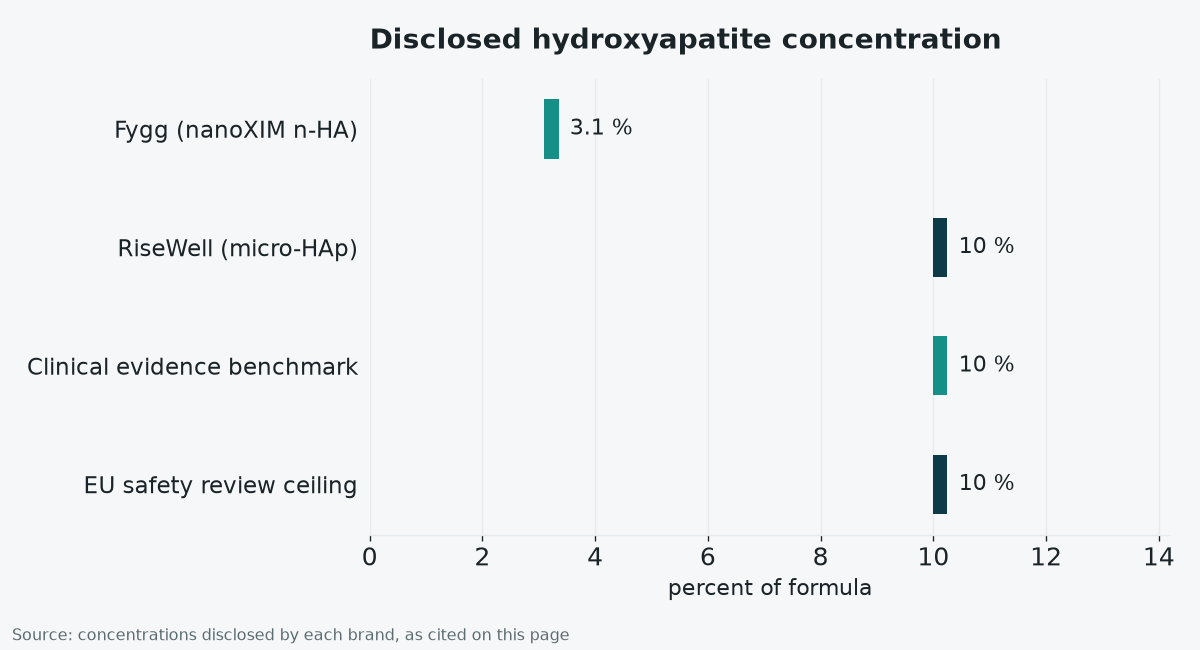
| Fygg Nano Hydroxyapatite Toothpaste | Nano-HAp (nanoXIM) | 3.1% nanoXIM | Fluoride-free | Yes (no essential oils either) | 4 oz | Mid | Best for microbiome-conscious users |
| Huppy Toothpaste Tablets (n-HA) | Nano-HAp | Not disclosed | Fluoride-free | Yes | 62 tablets (1 month) | Budget-mid | Best for travel, zero-plastic |
| Boka Mint Coconut Cream (Sensitive) | Nano-HAp | Not disclosed | Fluoride-free | Yes | 4 oz | Mid | Best for highly sensitive teeth |
RiseWell Mineral Toothpaste: best overall
Best for: People who want a verified concentration, prefer micro-HAp over nano, and travel frequently (TSA-approved 3.4 oz).
RiseWell is the brand that started the mainstream conversation about fluoride-free remineralization in the US, and its flagship Mineral Toothpaste still earns the top spot here for one simple reason: it tells you exactly what it contains. The formula uses 10% micro-hydroxyapatite sourced from a mine in France, a concentration supported by multiple clinical studies on enamel remineralization. Most competitors list “hydroxyapatite” in their ingredient deck without specifying how much you are actually getting.
The micro-particle size (as opposed to nano) matters to some users. While the research on nano-HAp is generally reassuring, those who prefer to avoid any uncertainty around ultra-fine particles have a verified, data-backed alternative in RiseWell. The 3.4 oz tube lasts up to three months with twice-daily use, which makes the per-brush cost lower than the shelf price suggests.
The ingredient list is short and readable: silica, sorbitol, glycerin, xylitol, hydroxyapatite, calcium carbonate, propanediol, potassium cocoate, stevia, and a blend of wild mint, peppermint, cinnamon, orange, lemon, tea tree, and eucalyptus extracts. No SLS, no propylene glycol, no artificial flavors. The taste is a genuine wild-mint blend that does not burn. The lack of foam takes a few days to adjust to; after that, most users report their mouth feels cleaner than with any conventional paste.
You can find the full hydroxyapatite hub on Enamelly for a deeper look at what distinguishes micro from nano particle sizes and why concentration thresholds matter.
- Pros: 10% concentration disclosed; micro-HAp (non-nano); SLS-free; fluoride-free; TSA-approved size; vegan and gluten-free; Made in USA
- Cons: No foam (adjustment period for some); only one flavor in the original Mineral line; not the cheapest per oz
Boka Ela Mint Nano-Hydroxyapatite Toothpaste: best nano-HAp daily driver
Best for: Anyone who wants nano-HAp in a familiar toothpaste format, multiple flavor options, and a brand that has been in the HAp space long enough to have a real track record.
Boka was one of the first US brands to build its entire product line around nano-hydroxyapatite, and the Ela Mint formula is the one most people start with. The ingredient list is longer than RiseWell’s, which reflects Boka’s choice to include botanical extracts like aloe vera, cucumber, avocado, and mango alongside the HAp. Some users appreciate this; others want the absolute minimum number of ingredients.
The formula is fluoride-free and replaces sodium lauryl sulfate (SLS) with sodium lauroyl sarcosinate, a milder surfactant derived from coconut oil. It does produce a light foam, which makes the transition from conventional toothpaste easier. The peppermint-spearmint-wintergreen blend with a touch of cardamom is one of the more interesting flavor profiles in this category, and Boka offers a wide range of alternatives including Cinna Mint, Lemon Lavender, and Peppermint Blossom (with added probiotics) if Ela Mint is not your preference.
Boka does not disclose its n-HA concentration, which is a limitation worth noting. The clinical research showing 10% is the optimal threshold means you cannot directly compare Boka to RiseWell on this dimension. What you can say is that Boka has been on the market since 2019, has a large and vocal user base, and has not prompted any safety concerns in that time.
- Pros: Wide flavor selection; nano-HAp; SLS-free; fluoride-free; multiple pack sizes; widely available on Amazon and at Target
- Cons: HAp concentration not disclosed; contains sodium benzoate (a preservative some users avoid); slightly more complex ingredient list
Davids Hydroxi sensitive+whitening: best for sensitivity and whitening
Best for: People dealing with tooth sensitivity who also want natural whitening without peroxides, and who care about ingredient sourcing transparency.
Davids built its reputation on premium natural toothpaste, and the Hydroxi line is where the brand entered the HAp space in a serious way. The sensitive+whitening formula uses rod-shaped nano-hydroxyapatite, which Davids specifies is the particle shape most strongly associated with enamel penetration in published research. The rods are sized to fit into dentin tubules, which are the microscopic channels that expose nerves to hot, cold, and sweet stimuli when enamel thins.
Beyond the HAp, the formula includes calcium carbonate and ultra-fine hydrated silica as gentle polishing agents, baking soda, coconut oil, xylitol, and peppermint, spearmint, and wintergreen oils. The whitening mechanism is mechanical and mineral-based rather than peroxide-based, so it polishes and fills rather than bleaches. Expect gradual improvement rather than a dramatic overnight shift.
The ingredient list is EWG Verified, meaning every ingredient has been reviewed against the Environmental Working Group’s safety criteria. For users who prioritize third-party safety vetting, that certification carries real weight. The 4 oz tube comes packaged in a metal tube with a recyclable cardboard box, which aligns with Davids’ sustainability positioning.
- Pros: Rod-shaped nano-HAp; EWG Verified ingredients; SLS-free; fluoride-free; baking soda and coconut oil enhance whitening; 4 oz; Made in USA
- Cons: HAp concentration not disclosed; peppermint oils may be too intense for users with mouth sores; premium price tier
The quarter-gram figure is the pea-sized amount dentists recommend for adults, and most people squeeze out two to three times that because toothpaste adverts show a full brush head. Using the correct amount is what makes an expensive hydroxyapatite tube affordable, and children under three should get a rice-grain smear instead.
Fygg Nano Hydroxyapatite Toothpaste: best for microbiome-conscious users
Best for: People who have read about the oral microbiome, want to avoid essential oils that can disrupt beneficial bacteria, and prefer a prebiotic-forward formula.
Most HAp toothpastes include essential oils (peppermint, tea tree, eucalyptus) as flavoring and antimicrobial agents. Fygg takes a different position: its formula contains no essential oils, no SLS, and no emulsifiers, based on the argument that these compounds disrupt the oral microbiome’s balance of beneficial bacteria alongside the harmful ones.
Instead, Fygg uses nanoXIM nano-hydroxyapatite at 3.1%, sourced from Fluidinova, a Portuguese company that produces pharmaceutical-grade synthetic HAp. The formula adds L-arginine (an amino acid that fills dentin tubules and reduces sensitivity), chicory root as a prebiotic, xylitol, non-GMO vegetable glycerin, and monk fruit extract for sweetness. The flavor is mild mint, though texture reviews are split: some users find the gel-like consistency unusual at first.
The 3.1% concentration is lower than RiseWell’s 10%, which is a real tradeoff to consider. Fygg’s argument is that the nanoXIM particle quality and the prebiotic-L-arginine combination compensates, though head-to-head concentration comparisons are not available in published literature. If you are primarily motivated by enamel remineralization, RiseWell’s 10% micro-HAp gives you more documented reassurance. If oral microbiome support is your primary concern, Fygg is the most differentiated option in this category.
- Pros: Discloses source and type of HAp (nanoXIM by Fluidinova); no essential oils; no SLS, emulsifiers, or detergents; L-arginine for sensitivity; chicory root prebiotics; fluoride-free; recyclable packaging
- Cons: 3.1% HAp concentration is below the 10% benchmark used in most clinical studies; gel texture is not universally liked; newer brand with less long-term user data
Huppy Toothpaste Tablets (nano-HAp): best for travel and zero-plastic
Best for: Frequent travelers, people who want to eliminate toothpaste tubes entirely, and anyone drawn to the tablet format for its convenience and sustainability profile.
Huppy takes nano-hydroxyapatite out of the tube format entirely and puts it into a chewable tablet. Each tin contains 62 tablets, enough for one month of twice-daily brushing. You chew one tablet to release a gentle foam, then brush as you normally would. The result is essentially the same as a paste, minus the plastic packaging and the TSA liquid-rule headache.
The tablets are fluoride-free, SLS-free, and free from parabens, artificial sweeteners, and microplastics. The tin format means you can toss them in a carry-on, gym bag, or hiking pack without worrying about caps popping off or tubes exploding at altitude. Huppy has built a meaningful following in the zero-waste oral care segment, and the ingredient transparency on its product listings is consistent with other clean-label HAp brands in this guide.
The tablet format is not for everyone. If you have a strong preference for traditional paste texture, the transition requires a brief adjustment. Children may also find the chew-then-brush sequence less intuitive than squeezing paste onto a brush. But for the sustainability-oriented adult traveler or commuter, this is the format that makes the most sense, and Huppy has executed it with clean ingredients.
If you are also looking at fluoride-free options more broadly, our fluoride-free toothpaste guide compares HAp against other fluoride-free active ingredients like xylitol and calcium carbonate.
- Pros: Zero plastic (reusable tin); TSA-approved; nano-HAp; SLS-free; fluoride-free; vegan, cruelty-free, gluten-free; convenient chew-and-brush format
- Cons: HAp concentration not disclosed; tablet texture requires adjustment; not suitable for users who strongly prefer paste; limited flavor options per tin size
Boka Mint Coconut Cream (Sensitive): best for highly sensitive teeth
Best for: Users with pronounced tooth sensitivity who want a formula specifically designed for that purpose, with a gentler, non-minty flavor profile.
Boka’s Mint Coconut Cream is its dedicated sensitive-teeth formula within the nano-HAp lineup. Where Ela Mint prioritizes fresh flavor complexity, this formula pulls back on intensity: the coconut cream base softens the mint note significantly, making it far more tolerable for people whose gums or exposed dentin react poorly to sharp peppermint or spearmint flavors.
The nano-HAp works the same way in this formula as in Ela Mint, targeting the microscopic fissures and tubules that sensitize teeth. The addition of coconut oil-derived ingredients adds a mild conditioning layer. This is a niche pick; if your sensitivity is mild, Davids Hydroxi or RiseWell will serve you equally well. But for users who have tried conventional sensitivity toothpastes (typically potassium nitrate-based) and found the flavor or the approach unsatisfying, this nano-HAp sensitive formula offers a genuinely different mechanism, and the gentler taste makes daily compliance easier.
- Pros: Specifically formulated for sensitive teeth; gentle coconut cream flavor; nano-HAp; SLS-free; fluoride-free; 4 oz
- Cons: HAp concentration not disclosed; more limited availability in physical stores vs. Ela Mint; coconut flavor is not for everyone
How we picked these products
No product was tested firsthand by this editorial team. Our selection used the following criteria applied consistently across all candidates:
- Ingredient verification: We reviewed the full ingredient list for each product directly from the brand’s product page or from the Amazon listing. HAp type (nano vs. micro) and concentration (where disclosed) were both noted. Products that listed “hydroxyapatite” without specifying any form were flagged as lower transparency.
- Absence of flagged ingredients: We filtered for SLS-free formulas. SLS (sodium lauryl sulfate) is a surfactant associated with mucosal irritation and canker sores in some users. All six products pass this filter.
- Published clinical context: Where HAp concentrations are disclosed, we cross-referenced against the body of clinical literature. Multiple peer-reviewed studies, including a 2016 study in the Journal of Indian Orthodontic Society and a 2019 study in BMC Oral Health (PMID 31711430), have established 10% nano-HAp as effective at preventing and reversing enamel demineralization in controlled trials.
- Market availability: All products are currently sold on Amazon.com in the US. No products with discontinued ASINs or brands that have gone inactive were included.
- Aggregated public reception: We reviewed publicly available user discussions on Reddit, Amazon Q&A sections, and dental professional blogs to identify common real-world complaints (texture issues, sensitivity reactions, taste problems) and incorporated these into the pros and cons for each pick.
- Safety review currency: We cross-referenced each product against available regulatory and third-party safety assessments, including the European Commission’s Scientific Committee on Consumer Safety opinion on nano-HAp (published 2021) and the EWG Verified standard where applicable.
What to look for in a hydroxyapatite toothpaste
Nano vs. micro hydroxyapatite: does the size matter?
Most HAp toothpastes on the US market use nano-hydroxyapatite (n-HA), with particle sizes typically in the 20 to 80 nanometer range. RiseWell is the major exception among popular brands, using micro-hydroxyapatite (larger particles, in the micrometer range). The clinical research on remineralization and sensitivity reduction was largely conducted with nano-HAp at 10% concentration, originating from Japanese dental research in the 1980s through 2000s. Micro-HAp at 10% (RiseWell’s positioning) is supported by the same concentration benchmark, though it relies on different surface-deposition mechanics since the larger particles cannot penetrate dentin tubules as directly. For pure enamel surface remineralization, both sizes have supportive data. For dentinal hypersensitivity (the classic hot-cold-sweet sensitivity), nano-HAp that can penetrate the tubules has a mechanistic advantage. If your primary goal is sensitivity reduction, nano-HAp is the better-supported choice mechanistically. If your goal is enamel surface rebuilding and you prefer to avoid nano particles, micro-HAp at 10% is a reasonable alternative with comparable remineralization evidence.
Concentration: why 10% matters
The 10% HAp benchmark comes from multiple clinical studies that compared different concentrations. Below 10%, remineralization effects are measurable but smaller. Above 10%, benefits plateau and cost increases. Most brands do not disclose their concentration, which makes independent evaluation harder. When a brand explicitly states 10% (as RiseWell does), it is making a specific, verifiable claim that can be held against the published evidence base. The 2019 BMC Oral Health study (PMID 31711430) is one of the clearest head-to-head comparisons available, and it used 10% nano-HAp as the active concentration.
HAp vs. fluoride: what the evidence actually says
All six products in this guide are fluoride-free. That is a deliberate editorial choice reflecting the primary audience for HAp toothpaste. Fluoride remains the most extensively studied and most widely endorsed anticaries agent in dentistry; it is the standard against which HAp is measured, not a competitor being replaced. Fluoride and hydroxyapatite are not mutually exclusive: some formulas combine both. The reason most people seek out HAp specifically is to move away from fluoride, and the research shows that nano-HAp at 10% is non-inferior to fluoride toothpaste for cavity prevention in several published trials. A 2020 systematic review in the Journal of Dentistry examined seven randomized controlled trials and found HAp-based toothpastes performed comparably to fluoride on early caries lesion reversal. If you use fluoridated water or have a high caries risk, discuss the tradeoff with your dentist before switching entirely. No product in this guide should be positioned as a fluoride replacement without that conversation happening first.
SLS and surfactants
Sodium lauryl sulfate creates foam and helps distribute toothpaste, but it also disrupts the oral mucosal lining and is linked to increased frequency of aphthous ulcers (canker sores) in susceptible individuals. Every product in this guide either omits surfactants entirely (Fygg) or replaces SLS with milder alternatives like sodium lauroyl sarcosinate or potassium cocoate. If you get frequent canker sores, SLS elimination should be a priority alongside the HAp itself.
Particle source and quality
Not all nano-HAp is the same. Fygg’s use of nanoXIM from Fluidinova is a specific, pharmaceutical-grade synthetic HAp with published particle characterization data. RiseWell sources micro-HAp from a French mine (naturally derived). Davids specifies rod-shaped particles. Boka uses “biomimetic mineral form” without a named supplier. From a consumer standpoint, the most honest answer is that pharmaceutical-grade synthetic HAp has tighter quality controls than mineral-derived HAp, but both have been used in clinical research without safety concerns emerging.
Frequently asked questions
Is hydroxyapatite toothpaste as effective as fluoride toothpaste for preventing cavities?
Multiple published clinical trials show that 10% nano-hydroxyapatite toothpaste is non-inferior to fluoride toothpaste for caries prevention in children and adults. A 2019 study in BMC Oral Health (PMID 31711430) found 10% nano-HAp paste equivalent to amine fluoride toothpaste for preventing and reversing early decay. These results apply specifically to 10% concentrations; lower-concentration products have weaker evidence. Fluoride remains the most extensively studied and ADA-recognized anticaries agent; HAp is a well-supported alternative, not a proven replacement.
Can I use hydroxyapatite toothpaste if I already have cavities or active decay?
HAp toothpaste can remineralize early-stage demineralization (white spot lesions and softened enamel), but it cannot repair cavities that have already progressed into dentin or pulp. Those require professional treatment. Think of HAp paste as a daily maintenance and prevention tool rather than a treatment for existing decay. If you have active cavities, see your dentist and discuss whether fluoride or HAp is the right maintenance approach post-treatment.
How long does it take for hydroxyapatite toothpaste to show results?
For sensitivity reduction, many users report a noticeable change within two to four weeks of consistent twice-daily use. For enamel remineralization of white spot lesions, controlled studies typically measure over 12 weeks. Whitening effects from the mechanical polishing agents take four to eight weeks to become visible, depending on the degree of surface staining and the abrasivity of the formula.
Is nano-hydroxyapatite safe to swallow?
Hydroxyapatite is the primary mineral in human teeth and bones. Swallowing small amounts during brushing poses no known toxicity risk; it is essentially the same compound your body uses to build and repair mineralized tissue. The European Commission’s Scientific Committee on Consumer Safety reviewed nano-HAp in toothpaste and concluded it is safe at concentrations up to 10% when particles are rod-shaped and within specified size ranges. RiseWell specifically notes its micro-HAp formula is “100% safe to swallow.”
Which hydroxyapatite toothpaste works best for sensitive teeth specifically?
For pronounced sensitivity, the most targeted options are Davids Hydroxi sensitive+whitening (rod-shaped nano-HAp that fills dentin tubules, plus EWG Verified ingredients) and Boka Mint Coconut Cream (gentle flavor profile that does not aggravate reactive gums or exposed enamel). Fygg’s addition of L-arginine, a compound that blocks dentin tubule fluid movement, also provides a separate sensitivity-reduction mechanism on top of the HAp remineralization.
Do I need to use hydroxyapatite toothpaste twice a day, or will once a day work?
Clinical studies supporting HAp efficacy use twice-daily brushing as the protocol. Once-daily use will still deliver some remineralization benefit, but the evidence base is built around two sessions per day. More practically: enamel experiences acid challenges throughout the day from food and bacteria, and HAp toothpaste partly neutralizes that by replenishing mineral between acid attacks. Once a day gives you only one replenishment window. Twice daily is the minimum worth committing to.