How to Brush a Cat’s Teeth (Without Losing a Finger)
By Enamelly Editorial Team
Editorial note: This article contains links to product categories on enamelly.com. Some may carry affiliate relationships. All recommendations reflect VOHC seal status and established veterinary guidance. Questions about our editorial process: contact us here.
Most cats would rather eat the toothbrush than tolerate it near their face. That is not a character flaw; it is a training problem. Brushing your cat’s teeth is genuinely possible, but only if you stop thinking about it as a dental appointment and start treating it as a slow trust-building exercise that happens to end with clean teeth. This guide walks you through that process from first contact to a consistent daily routine, including what to do when your cat is actively uncooperative and when brushing alone is not going to cut it.
The Short Answer
To brush a cat’s teeth, start by letting them taste pet-formulated enzymatic toothpaste from your finger over several days, then graduate to a finger brush, and finally a soft-bristle pet toothbrush. Focus on the outer surfaces of the upper back teeth, use small circular motions, and keep each session under two minutes. Never use human toothpaste; fluoride and xylitol are toxic to cats. The Veterinary Oral Health Council (VOHC) recommends daily brushing as the gold standard for home dental care.
How to Brush a Cat’s Teeth: Complete Overview
Brushing a cat’s teeth requires a two-week graduated introduction, the right toothpaste, and a consistent daily commitment. Start with pet-formulated enzymatic toothpaste on your fingertip, offered as a lick once daily for three days, so your cat associates the flavor with a low-pressure interaction. Days four through seven, let your finger rest briefly on the outer gum surface near the upper canines; contact under five seconds is the target. On days eight through eleven, swap your finger for a silicone finger brush with toothpaste applied. Expect the new texture to reset tolerance slightly. From day twelve onward, transition to a small-headed soft-bristle cat toothbrush held at a 45-degree angle to the gumline, using short circular strokes on the outer surfaces only. Inner surfaces do not require brushing because the tongue manages them. A full session covering all accessible outer teeth takes under two minutes. Never use human toothpaste: fluoride is toxic to cats, and xylitol causes acute liver failure. Use only products bearing the VOHC Seal of Acceptance.
What Happens When You Skip the Brushing
Plaque forms on a cat’s teeth within 24 hours of eating. Left alone, it mineralizes into tartar in as little as three to five days. Tartar harbors bacteria that drive gingivitis, and gingivitis that goes untreated progresses to periodontal disease, which is painful, destroys the structures holding teeth in place, and can allow oral bacteria to enter the bloodstream.
According to the American Veterinary Dental College (AVDC), periodontal disease is the most common clinical condition in adult cats, with most cats showing some degree of it by age three. That number is not a scare tactic; it is the baseline you are working against the moment you skip a cleaning.
“Tooth brushing is the single most effective way of reducing dental plaque and should be performed on a daily basis.” (American Veterinary Dental College, avdc.org)
A 2023 review published in Frontiers in Veterinary Science and indexed in PubMed Central (PMC10562112) examined home dental care modalities across companion animal species and found that mechanical plaque removal via toothbrushing consistently outperformed chemical-only approaches, including enzymatic gels and water additives, when measured against gingivitis scores at 30 days. Daily brushing disrupts plaque before it hardens. Nothing else available for home use does this as effectively.
Dental chews, water additives, and dental diets carry VOHC approval for reducing plaque or tartar on some products, and they are worth using as adjuncts, but they are not a replacement for mechanical removal.
Home Dental Care Options Compared
Not all home care options deliver the same results. The table below compares plaque removal effectiveness, VOHC seal availability, effort level, and suitability for cats that resist handling, based on published veterinary dental guidelines and the VOHC accepted products list.
| Method | Plaque Removal | VOHC-Accepted Products | Works for Resistant Cats | Notes |
|---|---|---|---|---|
| Daily toothbrushing | Highest (mechanical) | Yes (toothpastes) | No; requires training | AVDC and VOHC gold standard |
| Enzymatic dental gel (no brush) | Moderate (chemical only) | Yes | Yes; applied with finger | Best fallback when brushing fails |
| Dental chews and treats | Low to moderate | Yes (select products) | Yes; most cats accept treats | Verify VOHC seal; many lack it |
| Water additives | Low | Yes (select products) | Yes; passive delivery | Some cats refuse altered water taste |
| Dental wipes | Low to moderate | Limited | Better for brushing refusers | Transition step; miss the gumline |
| Dental diet | Moderate (kibble abrasion) | Yes (select formulas) | Yes; everyday food | Works on crown surface, not below gumline |
What You Actually Need Before You Start
Keep this list short. Overcomplicating the setup is one of the main reasons people quit before the routine takes hold.
Toothpaste: the non-negotiable
Use only pet-formulated enzymatic toothpaste. Human toothpaste contains fluoride, which is toxic to cats when swallowed, and many varieties now contain xylitol, which causes severe hypoglycemia and liver damage in pets. Enzymatic formulas work differently from human toothpaste: they rely on enzymes to break down plaque chemically rather than on foaming abrasives, so your cat does not need to “spit.” Poultry and malt flavors tend to get the best acceptance. Look for products that have earned a VOHC Seal of Acceptance, which means controlled studies confirmed they reduce plaque or tartar. The full approved list is at vohc.org/accepted-products/.
Applicator options
- Your finger (for introduction only)
- A silicone finger brush (the usual starting point for training)
- A small-headed soft-bristle toothbrush designed for cats or small dogs (the end goal for most owners)
Skip the “dental wipes” stage unless your cat absolutely refuses any brush form; wipes reduce plaque somewhat but miss the gumline where bacteria concentrate most.
Step-by-Step: Building Up to a Full Brush
The process described below is built on the graduated desensitization protocol outlined in AVDC and veterinary behavior guidelines: exposure starts with taste only, advances to touch, then to the tool, with each stage requiring consistent tolerance before progressing. Budget at least two weeks. Some cats need a month. That is fine.
Days 1-3: Toothpaste as a treat
Put a small amount of enzymatic toothpaste on your fingertip and let your cat lick it off. Do this once a day, in a calm moment, away from feeding time so there is no competition for attention. The goal here is zero: you are not cleaning anything. You are just teaching your cat that toothpaste taste equals a pleasant, low-pressure interaction.
Days 4-7: Finger on the teeth
Once your cat willingly licks toothpaste from your finger, start letting your finger rest briefly on their outer gum surface, still with toothpaste on it. Aim for the upper canines first; they are the easiest to access without opening the mouth fully. Keep contact under five seconds per session. If your cat pulls away, let them go. Restraint at this stage destroys the training.
Days 8-11: Introduce the finger brush
Fit the silicone finger brush, apply toothpaste, and repeat the same gentle contact. The texture is new and mildly surprising for most cats, so expect a step back in tolerance. Two or three brief contacts per session is sufficient. End each session before your cat gets frustrated, not after.
Days 12-14 onward: Transition to toothbrush
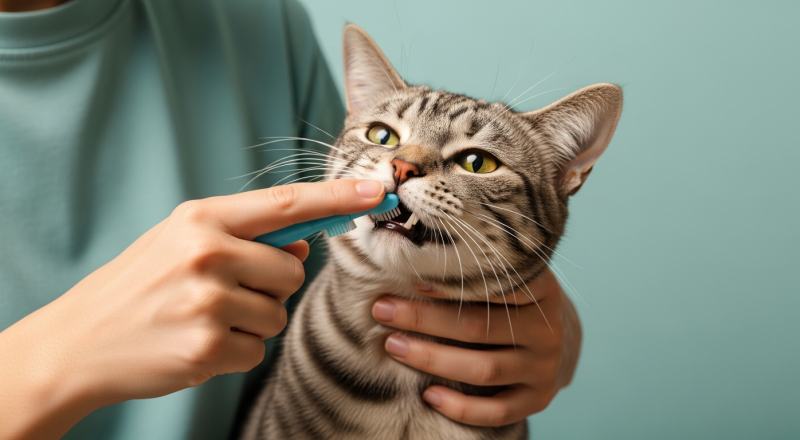
If your cat accepts the finger brush with minimal fuss, introduce a small-headed cat toothbrush. Hold the bristles at roughly a 45-degree angle to the gumline and use short circular strokes on the outer surfaces of the upper teeth, then the lower. You do not need to clean the inner (tongue-side) surfaces; the cat’s tongue manages most of that surface on its own. Focus each session on the back upper premolars and molars, where tartar accumulates fastest.
A complete session covering all accessible outer surfaces takes under two minutes once your cat is trained. Stop at any time if your cat shows clear distress signals: tail lashing, flat ears, growling, or a sudden freeze.
How Often to Brush
Daily is the target. The VOHC and the AVDC both endorse daily brushing as the most effective home-care frequency because plaque recolonizes tooth surfaces within 24 hours. If daily is not realistic for your schedule, three to four times per week provides meaningful benefit. Twice weekly is better than nothing. Once weekly is largely symbolic from a plaque-control standpoint.
Set a consistent time, ideally tied to something you already do daily, like brushing your own teeth. Cats respond well to routine, and a predictable cue helps them anticipate the interaction rather than be caught off guard by it.
What to Avoid
Human toothpaste: Never. Fluoride is poisonous to cats, and xylitol (now common in mint and whitening formulas) is acutely toxic. One tube within reach of a curious cat can be fatal.
Baking soda: Sometimes suggested as a DIY alternative. It is abrasive without being enzymatic, highly alkaline, and can disrupt the oral pH cats need. Skip it.
Forcing the mouth open: You do not need to hold the jaw open for effective brushing. Attempting it with an unwilling cat will get you bitten and your cat will associate brushing with a fight. Work on the outer surfaces only; they account for the majority of accessible plaque.
Inconsistency: A twice-daily session one week followed by two weeks of nothing does more psychological harm than good. A modest daily habit outperforms an aggressive irregular one.
Children’s toothbrushes designed for humans: The heads are too large, the bristles often too stiff, and the handle angle is wrong. Use a brush made for cats.
Troubleshooting: Your Cat Simply Refuses
Some cats will not accept a toothbrush regardless of how gradual your approach. That is a real outcome, not a personal failure. A few things worth trying before concluding it is impossible:
Try a different toothpaste flavor. Acceptance often hinges entirely on taste. If poultry is being refused, try tuna or vanilla-mint enzymatic formulas. The VOHC seal list covers multiple acceptable products in different flavors.
Change the location and position. Some cats tolerate brushing better on a high surface (a table or counter) where they feel more secure, or when approached from the side rather than face-on.
Use a wrap. For cats that scratch rather than bite, loosely wrapping your cat in a towel (a “purrito”) to secure the front paws can allow a brief brush attempt. Do not use this as a long-term solution; a cat that needs to be restrained every time will build a negative association regardless.
Consider dental gel without brushing. Some VOHC-accepted enzymatic gels can be applied to the gumline with a finger without any brushing motion. This is less effective than brushing, but far better than nothing for cats that refuse all brush contact.
For cats where brushing is simply not happening, the conversation shifts to professional cleaning under anesthesia and approved adjunct products. Your vet is the right person to build that plan. Explore your broader options in our pet dental care overview, which covers professional cleaning, water additives, and diet-based approaches in more detail.
Brushing Has Limits: Being Honest About What Home Care Can Do
Daily brushing prevents new plaque from hardening into tartar. It does not remove tartar that is already there, and it cannot treat active periodontal disease, tooth resorption (a condition specific to cats where the tooth structure breaks down from the inside), or stomatitis. If your cat already has visible brown or yellow buildup, bad breath that persists despite brushing, or any of the warning signs listed in the section below, brushing at home is a maintenance tool, not a treatment.
Professional dental cleaning under general anesthesia is the only way to fully clean below the gumline, probe pocket depth, take dental X-rays, and address disease already present. According to the American Veterinary Dental College, many cats need professional cleaning every one to three years even with consistent home brushing. Skipping professional cleanings because you brush at home is a common mistake that leads to tooth loss and chronic pain.
The AVDC guidance on home care is direct: tooth brushing is the single most effective method for reducing plaque in companion animals, but it is not a substitute for professional evaluation. Any change in eating behavior, new bad breath, or visible oral changes warrants a veterinary appointment regardless of how diligent your home routine is. Full AVDC client education resources are available at avdc.org.
When to See a Vet
Start brushing training at any age, but get a baseline oral exam from your veterinarian first, especially if your cat is over two years old. They can confirm there are no existing injuries, ulcers, or painful areas that would make training counterproductive or cruel.
Book a vet appointment if you notice any of the following:
- Persistent bad breath that is not explained by recent food
- Visible brown or yellow buildup on the teeth, particularly near the gumline
- Red, swollen, or bleeding gums
- Difficulty chewing, dropping food, or pawing at the mouth
- Excessive drooling, especially if new or sudden
- Weight loss combined with any of the above (pain while eating reduces food intake)
- Any tooth that appears loose, fractured, or discolored
These are signs of existing disease, not a brushing problem. A toothbrush will not fix them, and delaying professional care while attempting home management will allow the condition to progress.
Frequently Asked Questions
Can I use human toothpaste on my cat in an emergency?
No. Human toothpaste contains fluoride, which is toxic to cats, and many formulas now include xylitol, which causes acute liver failure and blood sugar collapse. If you have no pet toothpaste available, rinse your cat’s mouth with plain water or simply skip the session. Do not substitute human toothpaste.
My cat is 8 years old and has never had teeth brushed. Is it too late to start?
It is rarely too late to start, but get a dental exam before beginning. An older cat with existing disease may have painful areas that make training impossible without treating the underlying problem first. Once the vet clears the mouth as healthy enough for training, the same gradual acclimation process applies regardless of age, though older cats typically need a slower timeline.
How do I know if a cat toothpaste has actually been proven to work?
Look for the Veterinary Oral Health Council (VOHC) Seal of Acceptance on the label. Products earn this seal only by submitting controlled clinical trials showing they reduce plaque or tartar by a defined percentage. The full approved product list is maintained at vohc.org/accepted-products/. Not all enzymatic toothpastes have this seal; check before you buy.
Is a finger brush better than a toothbrush?
For training, yes: a finger brush gives you better control and feels less threatening to the cat. For long-term cleaning, a small-headed soft-bristle pet toothbrush reaches further into the gumline and covers more surface area per stroke. The ideal approach is to use the finger brush to build tolerance, then transition to a toothbrush once your cat is consistently comfortable.
My cat is calm for the first few seconds and then suddenly bites. What am I doing wrong?
You are probably going past their tolerance threshold without noticing the early warning signals. Cats typically give several seconds of tail flicking, skin rippling, or ear rotation before they bite. Watch for these cues and stop before they escalate. Keep each session shorter than your cat’s current tolerance, not right at its edge. Gradually extend duration only after consistent calm responses.
Do dental treats actually help if I cannot brush at all?
Some do. Products with the VOHC Seal of Acceptance have clinical evidence of reducing plaque or tartar in controlled trials. However, no treat or chew has been shown to be as effective as daily brushing at preventing periodontal disease. Treats and dental care adjuncts are meaningful supplements for cats where brushing is not possible, but they should be paired with regular professional veterinary cleanings rather than used as a complete substitute.