What Is Hydroxyapatite, Exactly?
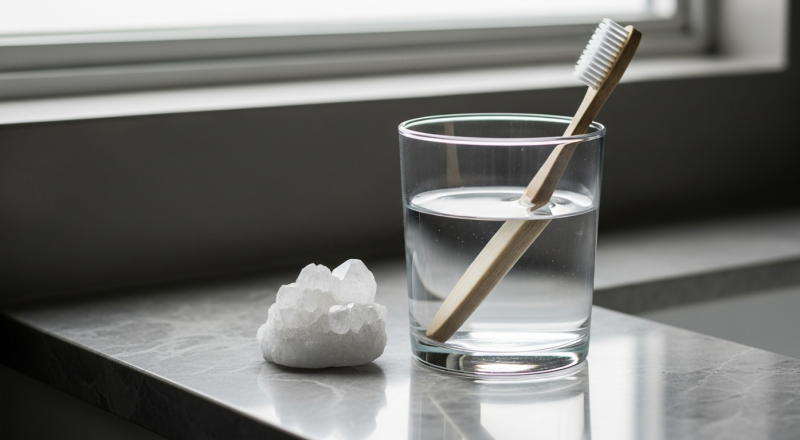
Hydroxyapatite is the natural mineral that makes up about 97 percent of your tooth enamel and 60 percent of your bone. It is a crystal form of calcium phosphate, and your body already builds your teeth out of it before a single tube of toothpaste ever touches them.
That fact matters because it explains why dentists and formulators got interested in adding it back into daily oral care in the first place.
Why your enamel is mostly hydroxyapatite
Enamel forms as tightly packed rods of hydroxyapatite crystals, arranged in a pattern strong enough to handle years of chewing, grinding, and temperature swings. There is no living tissue inside mature enamel, so once it wears down or loses minerals, your body cannot regrow it the way it heals skin or bone.
That is also why enamel erosion is a one-way street without help. Acidic foods, soda, and even normal digestion pull calcium and phosphate ions out of the crystal structure over time, leaving enamel thinner and more porous. Research on remineralization suggests that supplying those same minerals back to the tooth surface can help fill in microscopic gaps before they turn into visible damage. You can see how this plays out in practice in our hydroxyapatite toothpaste guide.
How hydroxyapatite toothpaste is supposed to help
When hydroxyapatite is added to toothpaste, the idea is simple on paper. The particles sit on the tooth surface and can bind into areas where natural mineral has already been lost, smoothing out roughness and helping block the microscopic tubules that carry sensitivity signals to the nerve.
This is different from how fluoride works, since fluoride strengthens existing enamel by converting it into a more acid-resistant form rather than adding new mineral mass. Some people prefer one mechanism over the other, and some brands combine strategies. If you are weighing the two approaches directly, our nano-hydroxyapatite vs fluoride comparison lays out the practical differences.
The different forms you will see on a label
Not all hydroxyapatite is identical once it lands in a tube. Manufacturers use different particle sizes and purity levels, and the label usually says either hydroxyapatite or nano-hydroxyapatite, which refers to particle size rather than a different compound entirely.
Some formulas also blend it with xylitol, calcium, or mild abrasives to support the same remineralization goal from multiple angles. Because this ingredient is swallowed in small amounts during normal brushing, plenty of people also want to know whether that is a concern, which our guide on swallowing hydroxyapatite toothpaste addresses directly.
What this means for your daily routine
You do not need to understand crystal chemistry to use this ingredient well. What matters is knowing that hydroxyapatite is not a synthetic additive foreign to your mouth. It is the same mineral family your teeth are already made from, delivered in a form small enough to interact with the enamel surface during brushing.
Whether it replaces fluoride in your routine or works alongside it depends on your enamel history, sensitivity level, and personal preference, not a one-size answer.