Best Whitening Toothpaste for Coffee and Wine Stains
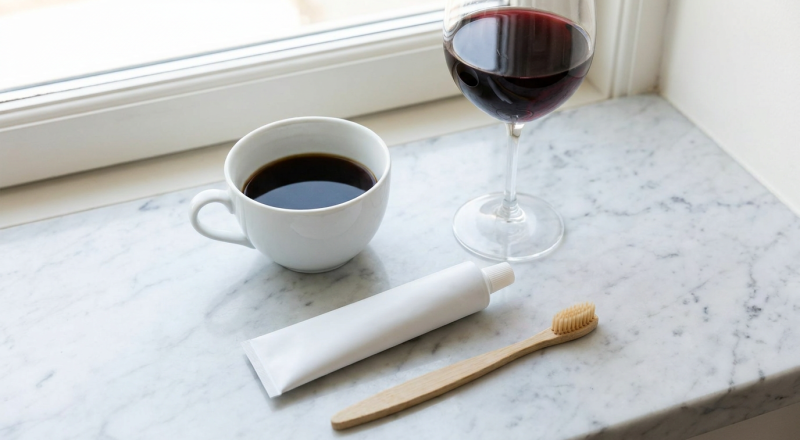
For coffee and wine stains, look for a toothpaste built around hydrated silica plus a polyphosphate such as sodium hexametaphosphate or tetrasodium pyrophosphate. Those two cover the job: the silica polishes existing surface stain away, and the polyphosphate binds to enamel so fresh pigment has less to grip.
Coffee, wine, and tea leave extrinsic stains, meaning pigment sitting on the outer enamel and in the protein film above it. That is the one kind of discoloration a toothpaste can genuinely reach.
Why Coffee and Wine Stain in the First Place
Tannins in both drinks bind readily to the pellicle, the protein layer that re-coats your teeth minutes after brushing. Wine adds acidity, which softens enamel briefly and lets pigment settle deeper into that film.
The practical consequence: rinsing with water straight after a cup does more good than brushing immediately does. Brushing softened enamel turns a surface stain problem into a surface wear problem.
The Ingredients Worth Looking For
Hydrated silica is the standard polishing agent, and its abrasivity depends on particle size rather than the wording on the box. The ISO ceiling for safe daily use is an RDA of 250, and pastes under 150 sit in the low to medium range.
Sodium hexametaphosphate and tetrasodium pyrophosphate work differently. They chelate surface minerals and leave a film that resists fresh staining, which is why they appear in most stain-control formulas.
Hydrogen peroxide shows up at low concentrations in some pastes. Contact time across a two minute brush is short, so expect modest results next to a tray or strip system.
Blue Covarine Shifts Shade Without Removing Stain
Some formulas add a blue pigment that deposits on enamel and pushes the perceived colour toward the cooler end. The effect is real and immediate, and it is optical rather than chemical.
Nothing wrong with that if you want teeth to look brighter today. It does not reduce the stain load, so pair it with an abrasive and a polyphosphate rather than relying on it alone.
If Your Teeth Are Already Sensitive
Stain-control pastes tend to sit at the higher end of the abrasivity range, and daily use over exposed dentin can make sensitivity worse. Alternating a whitening paste with a hydroxyapatite or potassium nitrate formula is the usual compromise.
Our breakdown of does whitening toothpaste damage enamel covers where the real risk sits. Worth reading before you commit to twice daily use.
What a Paste Will Not Fix
Intrinsic discoloration from ageing, tetracycline, or trauma sits inside the dentin, and no toothpaste reaches it. That is a conversation for your dentist.
Charcoal toothpaste is a common detour here, and the evidence behind it stays thin relative to the abrasion concerns. For specific product picks rather than ingredient theory, our best whitening toothpaste guide ranks formulas by mechanism.