Travel toothbrush: folding, capped and battery models compared
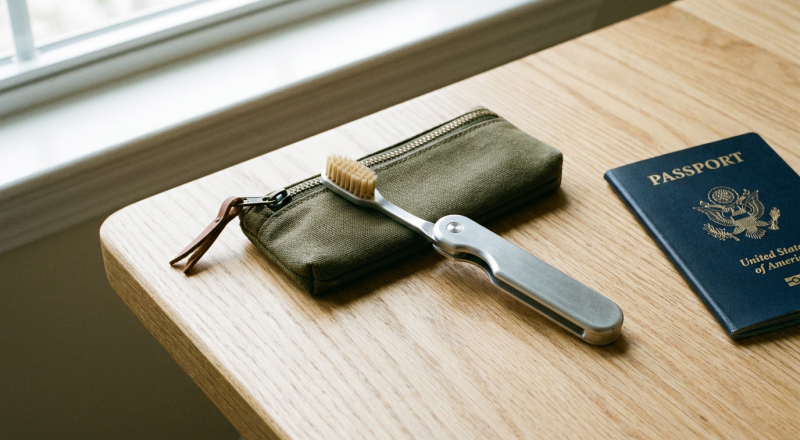
The best travel toothbrush depends on how you pack: a folding manual brush for the smallest footprint, a capped or cased brush for a wet head, or a battery brush if you want a powered clean. The TSA allows battery brushes in both carry-on and checked bags, with one rule for lithium batteries.
This guide sorts four named brushes by type, using the makers’ own product pages. It is general information, not dental advice.
Folding, capped and battery brushes compared
| Brush | Type | Power source | Packing feature | Source |
|---|---|---|---|---|
| GUM Travel Toothbrush | Folding manual | None | Tri-fold handle, bristles fold into it; soft bristles treated with an antibacterial solution; built-in tongue cleaner | sunstargum.com |
| Toob Brush | Cased manual | None | Replaceable brush head, refillable toothpaste tube and rinse cap inside one carrying case | yourhealthysmile.com |
| quip Sonic | Battery, capped | One AAA battery, up to 3 months under twice-daily use | Travel cover doubles as a protective cap | getquip.com |
| Philips One by Sonicare HY1100 | Battery, cased | Battery model; 13,000 microvibrations per minute | Compact travel case; $29.96 on the Philips US page | usa.philips.com |
Read on the maker pages, 10 October 2026. The GUM, Toob and quip pages show no usable price, so none is listed. The quip runtime is the brand’s figure, not a measured one.
Folding or capped: which suits a wet brush
A folding handle wins on size, and the GUM tri-fold is the clearest example on the list. The catch is the wet head: a folded brush is covered up while it may still be damp.
The American Dental Association advice, summarised in our electric toothbrush holder guide, is to let a brush air dry upright, because a moist brush in a closed container grows more microbes than one in open air. Use the cap or case for transit, then open it at the hotel.
Video: Travel Guider
Can you fly with a battery toothbrush
Yes. The TSA electronic toothbrush page lists carry-on and checked bags as allowed, with special instructions: devices with lithium metal or lithium ion batteries should go in carry-on baggage. The page was last updated on 5 September 2025, and it adds that the final decision rests with the TSA officer.
The page points to FAA rules on portable electronic devices for the detail. A one-AAA brush like the quip Sonic and a rechargeable model both fit a carry-on pouch.
Does a travel brush replace your normal one
A travel brush is a stand-in for a week or two, not a permanent swap. If you travel often, treat it as its own brush with its own replacement clock.
The replacement guide covers the three to four month rule and the sign that matters more, splayed bristles. Powered travel brushes also raise the question of whether a battery handle suits you at home, which our manual vs electric comparison answers for enamel.
If anything hurts or bleeds when you brush on the road, ask a dentist rather than changing brushes.
Questions readers ask
Can you take an electric toothbrush in a carry-on bag?
Yes. The TSA lists electronic toothbrushes as allowed in carry-on and checked bags, and says devices with lithium metal or lithium ion batteries should be carried in carry-on baggage. The TSA officer makes the final call at the checkpoint.
Which is better for travel, a folding or a battery toothbrush?
A folding manual brush packs smallest and needs no battery. A battery brush gives a powered clean and uses a replaceable AAA or a rechargeable cell. Pick by how much space you have and whether you want a powered brush.
Should you keep a travel toothbrush in a closed case?
Only while it is moving. American Dental Association guidance is to store a toothbrush upright and let it air dry, since a moist brush in a closed container grows more microbes. Take it out of the cap or case once you arrive.