Electric toothbrush holder: what to look for before you buy
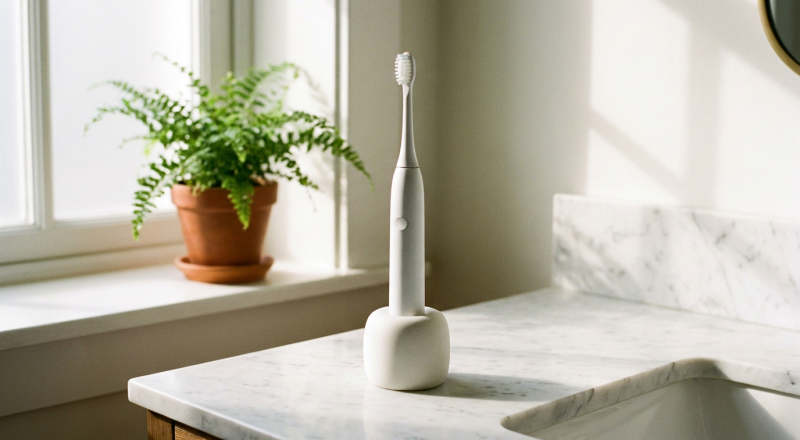
The best electric toothbrush holder keeps the brush upright, lets the head air dry, fits your charger, and wipes clean in seconds. Everything else, from UV lamps to star ratings, comes second.
Most listings sort by reviews and skip those four checks. Here is how to run them before you pay.
Start with how the head dries
The American Dental Association says to store toothbrushes upright after use and let them air dry. Its guidance adds that a moist brush in a closed container grows more microbes than one left in open air.
That rules out lidded caps and sealed pods for daily use. Look for an open top and a base with drainage, so water runs off the handle instead of pooling around the charging contacts.
Video: Practical Tech Fixes
What the ADA guidance means for a holder
| Checkpoint | ADA figure or guidance | What to check on the holder |
|---|---|---|
| Storage position | Upright, allowed to air dry | Open top, handle held vertical |
| Covers | Closed, moist storage promotes more microbial growth than open air | No lid for everyday use |
| Sharing | Toothbrushes should not be shared | One clearly separate slot per person |
| Head replacement | Every 3 to 4 months, sooner if bristles fray | Room to store spare heads dry |
| Sanitizer devices | Choose one cleared by the U.S. FDA | FDA clearance stated, not just “kills germs” |
| Soaking | One in vitro study: 3% hydrogen peroxide or Listerine cut bacterial load about 85% | Not a holder feature, a low-cost option |
Source: American Dental Association, Oral Health Topics, Toothbrushes.
Measure the charger, not the handle
Electric brushes sit on a charging base, and Oral-B and Philips Sonicare bases differ in shape and footprint. A holder built around one brand can leave the other wobbling.
If your household runs two brands on one counter, pick a holder with separate cutouts or a flat tray that takes both chargers side by side. Keep spare heads in a ventilated slot, since you will be swapping them on schedule. Our guide on when to swap toothbrush replacement heads covers the timing.
Suction cups versus adhesive versus freestanding
Suction cups need smooth, non-porous tile and tend to let go as humidity and temperature swing. Adhesive mounts hold better but can pull paint or grout when removed.
Freestanding bases cost you counter space but never fall. A weighted ceramic or stainless base is the safest pick for rented bathrooms.
UV sanitizing holders: read the claim carefully
The ADA notes that toothbrushes harbor bacteria, yet it also says there is no evidence those bacteria cause adverse health effects. So a UV holder solves a problem the evidence has not shown to exist.
If you still want one, the ADA advice is to look for FDA clearance. Some UV units also close around the head, which conflicts with open-air drying, so check that the chamber vents or opens after the cycle.
No holder extends a brush past its useful life. Follow the guidance on how often to replace your toothbrush, and pair it with the right bristle, since soft vs medium bristle toothbrushes wear at different rates.
Cleaning is the deciding feature
Holders collect toothpaste drips and standing water at the base. Choose one that comes apart or has a removable drip tray, and wash it weekly with warm soapy water.
Skip designs with narrow tubes you cannot reach inside. If you cannot see the bottom, you cannot clean it.
This is general information, not dental advice. Ask your dentist if you have a specific concern about brush hygiene.