Horse teeth: how many they have, how they grow and how age is read
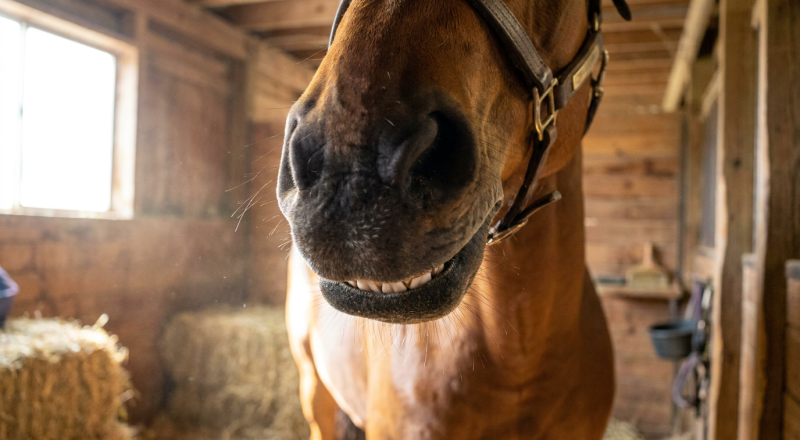
An adult stallion has 40 to 44 teeth and an adult mare has 36 to 40, according to the Merck Veterinary Manual. The gap is mostly the canines, which often never show in mares. Horse teeth also keep erupting through life to replace what grinding wears away, and that steady wear is how a vet estimates age.
How many teeth a horse has, by type
Most foals cut their first baby teeth within about two weeks of birth and carry 24 of them. Permanent molars arrive at roughly 1, 2 and 4 years, the baby incisors and premolars start falling out near 2.5 years, and the full adult set is usually in place by age 5.
| Tooth type | Count (upper / lower) | Permanent eruption age (years) | Mare vs stallion |
|---|---|---|---|
| Incisors | 6 / 6 | 2.5 to 4.5 | Same in mares and stallions |
| Canines | 2 / 2 | 4 to 5 | Often absent in mares |
| Premolars | 6 to 8 / 6 | 2.5 to 4; wolf teeth at about 5 to 6 months | Wolf teeth are not always present |
| Molars | 6 / 6 | About 1, 2 and 4 | Same in mares and stallions |
| Adult total | Stallion 40 to 44; mare 36 to 40 | All usually present by 5 | The gap comes from the canines |
| Baby (deciduous) set | 24 in most horses | First ones within about 2 weeks of birth | Replacement starts near 2.5 years |
Counts and ages are Merck figures, written by equine dental specialist Jack Easley. Individual horses vary, so treat each age as typical, not fixed.
If you already know the dog dental chart, notice how different the horse layout is. Dogs and cats keep a fixed tooth length, while a horse’s cheek teeth work like a long grinding battery pushed slowly up from the jaw.
Video: UNH Equine Program
Why horse teeth keep growing
Horses have hypsodont, or high-crowned, teeth. UC Davis describes them as teeth that continuously erupt from the gum line throughout life, so a grazing horse always has a fresh grinding surface.
That supply is not endless. The reserve crown below the gum gets used up with age, and UC Davis notes that longer-lived horses are starting to outlive their teeth. Senior horses often need softer feed for that reason.
How a vet reads age from the incisors
Age estimates come mainly from the lower front teeth. Merck lists a sequence: the dark cup is gone from the central incisors around 6, dental stars appear on them around 8, and Galvayne’s groove shows on the upper corner incisors around 10.
By about 15 that groove runs halfway down the tooth. The angle between upper and lower incisors also sharpens as a horse ages.
Breed, diet and environment all shift these signs, so a dental age is an estimate. Papers or a microchip record beat any mouth reading.
Vets also number horse teeth with the same modified Triadan system used on the cat dental chart, which is why an equine dental report reads like a grid of three-digit codes. Our teeth numbering chart explains how the quadrant digits work.
Floating and the signs of dental trouble
The upper jaw is wider than the lower one, so uneven wear leaves sharp enamel points on the outer edge of the upper cheek teeth and the inner edge of the lower ones. Filing them down is called floating.
Merck advises floating twice a year while the permanent teeth come in, roughly ages 2.5 to 5. After that, horses on grass usually need yearly care, while stalled horses on hay and grain need checks at least twice a year.
Call your vet if your horse drops half-chewed balls of feed (quidding), eats slowly, tilts its head while chewing or leaves whole grain in its manure. Drooling, bad breath, swelling on one side of the face and fighting the bit are also on Merck’s list.
This is general information, not veterinary advice. Your vet or a qualified equine dentist should examine the mouth, often under sedation.
Questions readers ask
How many teeth does a horse have?
According to the Merck Veterinary Manual, a mature stallion has 40 to 44 teeth and a mature mare has 36 to 40. The difference is mostly the canine teeth, which often do not appear in mares. Foals have 24 baby teeth.
Do horse teeth grow forever?
They keep erupting from the gum line throughout life to replace the surface lost to grinding, but the reserve crown below the gum is finite. In very old horses it can run out, which is why seniors often need softer feed.
How often should a horse's teeth be floated?
Merck advises twice a year while the permanent teeth come in, roughly from 2.5 to 5 years. After that, horses on grass usually need yearly care and stalled horses fed hay and grain at least twice-yearly checks. Your vet sets the exact interval.