Mouthguard toothbrush: what the U-shaped brushes can and cannot clean
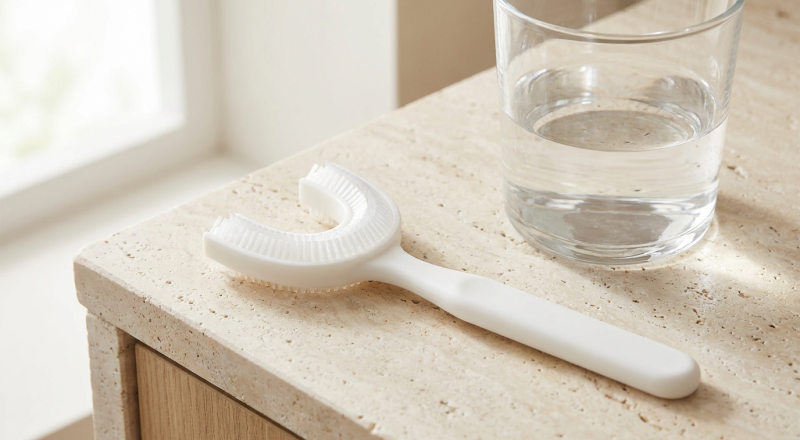
A mouthguard toothbrush can clean the outer, inner and chewing surfaces of your teeth at once, but only if it has real bristles and you move it. The one independent trial of a silicone hands-free model found it removed about as much plaque as not brushing at all. Nylon U-shaped brushes that you guide by hand show better numbers, mostly in studies their makers helped run.
What the published trials found
In 2020, a University of Florence team published a crossover trial in the International Journal of Environmental Research and Public Health. Twenty-two volunteer students each used four approaches: an automatic U-shaped brush with silicone bristles, a conventional powered brush, their usual brushing, and no brushing.
The U-shaped brush removed far less plaque than either the powered brush or normal brushing. Its result was not significantly different from no brushing, and the authors, who declared no conflict of interest, concluded it was not effective.
Video: Baseline Dental
A 2025 pilot in the Journal of Clinical Pediatric Dentistry points the other way. In 22 children aged 5 to 8, 30 seconds with an AutoBrush removed more plaque than 2 minutes with a soft manual brush, including at the gumline and between teeth. One co-author is listed at the company that sells AutoBrush, and the result comes from a single supervised session, not weeks of home use.
Silicone, nylon and how much you move it
The device that failed in 2020 used silicone nubs and ran hands-free. Current models from AutoBrush and Y-Brush use nylon, and AutoBrush states plainly that its brush is not a hands-free device: you are told to glide it side to side in a slow figure-eight until the timer stops.
| Device | Bristles (brand figure) | Cycle | Who it is sized for | Brand-site price |
|---|---|---|---|---|
| AutoBrush Sonic Pro | Nylon, 58,000 bristles per double-sided head | 30 s, guided side to side | Adult and preteen sizes | $89.00, tryautobrush.com |
| AutoBrush Sonic Pro Kids | Nylon U-shaped head | 30 s, guided side to side | Kids | $89.00, tryautobrush.com |
| Y-Brush Ultra (Clean240 head) | Nylon, 35,000 filaments | 20 s, one arch at a time | Adult | €129.99, y-brush.com (France) |
| Y-Brush KidsBrush | Clean240 S head | Not stated on the product page | Ages 4 to 12 | €49.99, y-brush.com (France) |
| Automatic U brush in Nieri et al. 2020 | Silicone | Automatic, hands-free | Adult volunteers | Brand not named in the paper |
Prices are what each brand site listed in October 2026. Bristle counts and cycle times are manufacturer figures. AutoBrush also states it holds ADA acceptance for its electric brushes and heads.
What a U-shaped brush cannot clean
A fixed U has to fit many different jaws. Crowded teeth, a narrow arch or back molars that sit outside the tray can end up with weak bristle contact, and no trial so far has tracked gum health over months.
Bristles from the side also do not replace floss or interdental brushes. Tight contacts between teeth still need their own cleaning, whatever handle you use.
If your choice is really between a manual vs electric toothbrush and something new, a regular powered brush has far deeper evidence behind it. The 2014 Cochrane review on powered brushing pooled 56 trials, where U-shaped devices have only a handful.
Where it might fit for kids
The kid case is the most plausible one. A child who fights a two-minute routine may tolerate 30 seconds of a guided U brush. That still trades off against a kids electric toothbrush with a small round head, which a parent can steer tooth by tooth.
If time is the problem, it is often cheaper to work on habits first. Timers, songs and taking turns can get kids to brush longer without changing the brush, and a parent can still check the back teeth afterwards.
This is general information, not dental advice. Ask your dentist before swapping your brush, especially with braces, crowns or gum disease.