Can you bring an electric toothbrush on a plane: the battery rules
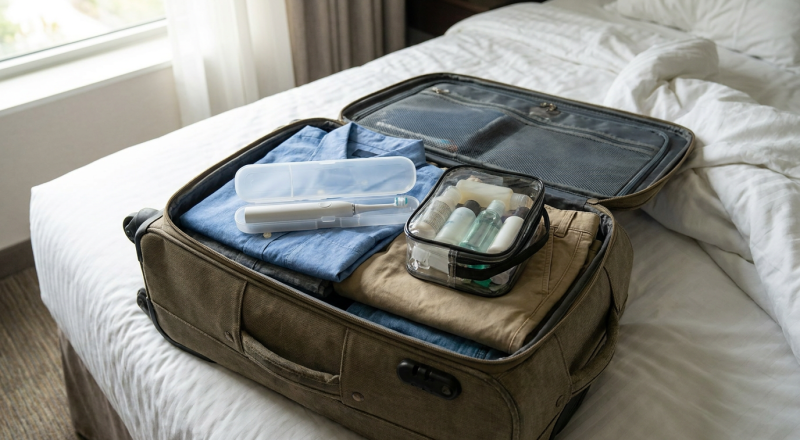
Yes, you can bring an electric toothbrush on a plane, in your carry-on or in your checked bag. The one condition is the battery. TSA allows electronic toothbrushes in both bags with special instructions, and the FAA says devices with lithium batteries should fly in the cabin with you.
What TSA and the FAA actually say
The TSA entry for electronic toothbrushes reads “Yes (Special Instructions)” for carry-on and for checked bags. Those instructions send you to the FAA rules for portable electronic devices.
The FAA wording is “should,” not “must.” Devices containing lithium metal or lithium-ion batteries should go in carry-on baggage, because flight crews are trained to handle a battery fire in the cabin. Nobody can reach one in the hold.
Video: Teeth Talk Girl
If you do check the brush, the FAA sets two conditions. It must be completely powered off, and it must be protected against accidental activation or damage. A handle that switches on inside a packed suitcase fails both.
Which battery your toothbrush runs on
The rules change with the cell inside the handle, so check your manual or the base of the handle first. If it says lithium-ion, the cabin advice above applies.
Brushes that take AA or AAA cells fall under a different FAA entry. Alkaline, nickel metal hydride and nickel cadmium batteries have no quantity limit and can go in either bag, as long as the terminals cannot touch metal. Leave the cells in the brush or tape the ends.
Spares follow stricter rules. Loose lithium-ion batteries and the power banks you use to recharge on the road are carry-on only, capped at 100 watt hours each. If your bag gets checked at the gate, take them out and keep them with you.
| Item | Carry-on | Checked bag | Source |
|---|---|---|---|
| Manual toothbrush | Yes | Yes | TSA: Toothbrush |
| Electric toothbrush with a built-in lithium-ion battery | Yes, and the FAA advises the cabin | Yes, if fully powered off and protected from accidental activation | TSA: Electronic Toothbrush, FAA PackSafe: devices with batteries |
| Toothbrush that runs on AA or AAA alkaline or NiMH cells | Yes, no quantity limit | Yes, terminals protected from short circuit | FAA PackSafe: batteries |
| Spare lithium-ion battery or power bank, up to 100 Wh | Yes | No | TSA: lithium batteries, FAA PackSafe: lithium batteries |
| Damaged or recalled battery-powered device | No, unless the battery is removed or made safe | No, unless the battery is removed or made safe | FAA PackSafe: devices with batteries |
Packing it so it arrives working
Use the travel lock if your model has one. Your manual lists the button sequence, which differs between brands and generations. No lock? A hard travel case keeps the button from being pressed.
Take the head off or cap it so the bristles stay dry and clean. On a long trip, pack a spare head too; our guide to Sonicare replacement heads shows which ones fit your handle.
If you use a subscription brush, the Burst toothbrush review covers its handle and charging. And if you are still deciding whether a powered brush is worth the suitcase space, start with manual vs electric toothbrush.
When an officer can still say no
TSA states that the final decision rests with the officer at the checkpoint. Airlines can set stricter rules than the FAA, and flights abroad follow that country’s regulator on the return leg.
Before a long-haul or international trip, check your carrier’s dangerous goods page. Keep the brush in your carry-on and you meet the strictest version of the rule wherever you fly.